On-Page SEO Checklist: 25 Steps to Perfectly Optimized Pages (2026)
I’ve audited more than 200 websites over the past five years. Want to know the most common problem I find? It’s not some obscure technical issue or missing schema markup. It’s basics. Fundamental on-page SEO elements either ignored or done wrong.
Title tags stuffed with keywords. H1s duplicated three times on one page. Images with alt text that says “image1.jpg.” URLs like “/p=?12345.” These aren’t edge cases. I see this stuff constantly, even on sites spending $10,000/month on content.
Here’s what I know: on-page SEO isn’t about chasing every minor optimization. It’s about systematically implementing the 20% of factors that drive 80% of results. This checklist covers 25 critical elements I check on every audit, organized by impact. If you nail these, you’ll outrank 90% of your competitors who are still guessing.
The three pillars of on-page SEO in 2026 are keyword optimization, content quality, and user experience. Google’s algorithms, and now AI engines like ChatGPT, reward pages that satisfy search intent better than anything else in the results. Let me show you how to do that.
Title Tags & Meta Elements (The First Things Google Sees)
1. Optimize Your Title Tag
What to do: Put your primary keyword at the front of your title tag. Keep it under 60 characters to avoid truncation in search results.
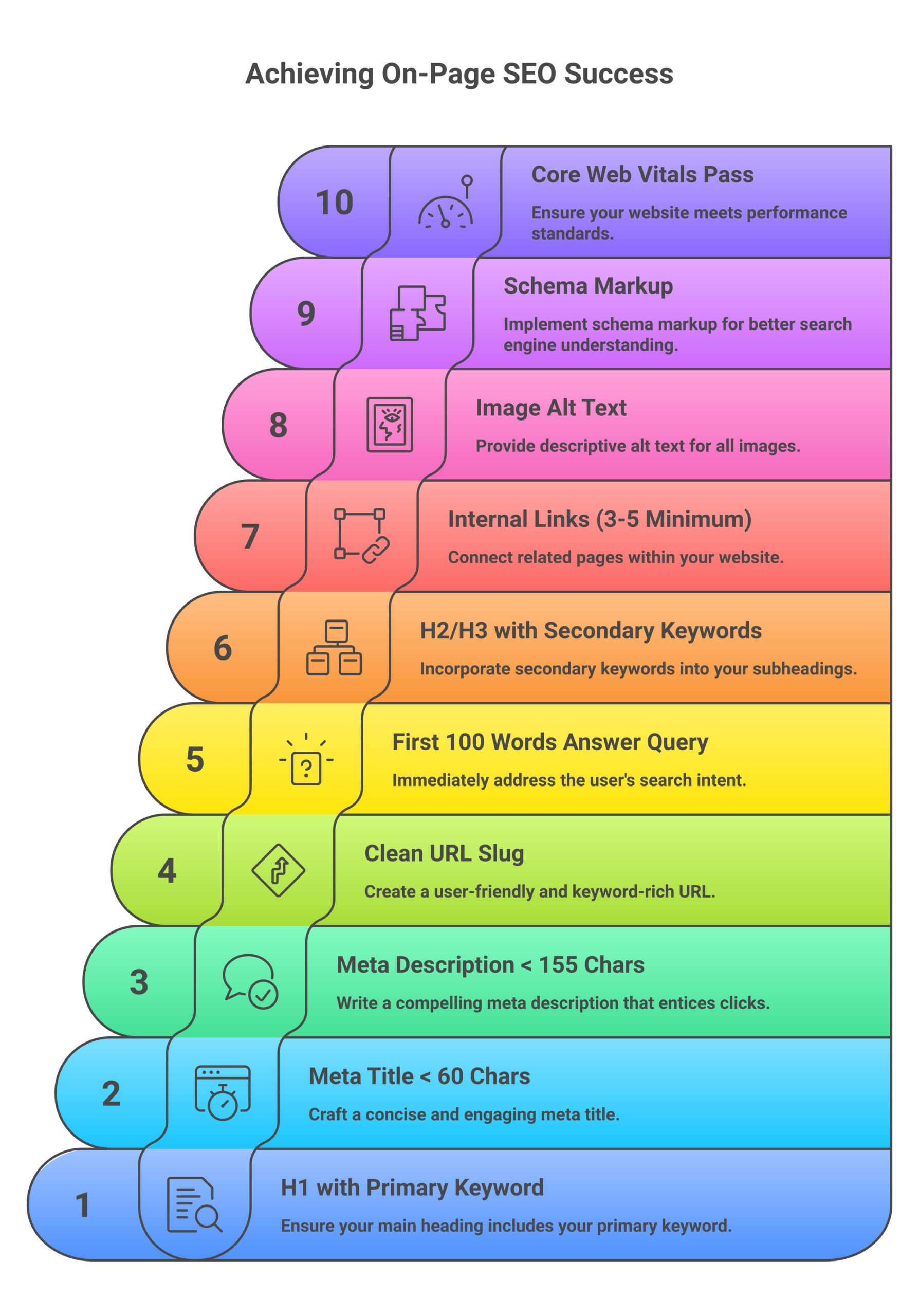
Why it matters: Your title tag is the first thing people see in SERPs. In 2026, it’s not just keywords, it’s click appeal + relevance signals. I’ve seen CTR double just from rewriting titles to be more compelling.
What I do: Use the format “Primary Keyword, Benefit or Modifier | Brand.” Example: “On-Page SEO Checklist, 25 Steps for Perfect Pages | Atlas Marketing.” Front-loaded keyword + value prop + brand trust signal.
2. Write Compelling Meta Descriptions
What to do: Write unique meta descriptions of 150-160 characters. Include your target keyword and a clear value proposition or CTA.
Why it matters: Meta descriptions don’t directly affect rankings, but they absolutely affect CTR. Higher CTR signals relevance to Google, which can indirectly boost rankings. I’ve seen a 30% CTR increase from better meta descriptions alone.
What I do: Think of meta descriptions as ad copy for organic search. Include the keyword (Google bolds it in results), state the benefit, add urgency or curiosity. Avoid generic phrasing like “Learn more about X.” Be specific.
3. Craft Clean, Keyword-Rich URLs
What to do: Use short, descriptive URLs with your primary keyword. Separate words with hyphens. Avoid numbers, special characters, and stop words.
Why it matters: Clean URLs are easier for users to read, remember, and share. They also provide topical signals to search engines. Compare /seo-glossary/technical-seo/on-page-seo-checklist/ to /p=?12345&cat=seo. Which one tells you what the page is about?
What I do: Keep URLs under 75 characters. Remove stop words (“and,” “the,” “of”) unless they’re needed for clarity. Use lowercase only. Never change URLs after publishing unless you set up 301 redirects, broken URLs kill SEO.
4. Set Canonical Tags Correctly
What to do: Add a canonical tag to every page pointing to the preferred version of that content. For most pages, this is self-referential (pointing to itself).
Why it matters: Canonical tags prevent duplicate content issues and consolidate ranking signals to your preferred URL. This is critical if you have similar pages, parameter-based URLs, or pagination.
What I do: Always use absolute URLs (full path including https://) in canonical tags, not relative paths. Check this in your page source. If you see <link rel="canonical" href="https://yourdomain.com/page/">, you’re good.
Header Tag Hierarchy (Structure Matters More Than You Think)
5. Use One H1 Per Page
What to do: Include your primary keyword in a single, clear H1 tag. Never use multiple H1s on one page.
Why it matters: The H1 tells both users and search engines what your page is about. It’s the most important on-page signal after your title tag. Multiple H1s dilute this signal and confuse page structure. I’ve seen sites with 4-5 H1s on a single page, don’t do that.
What I do: The H1 should match or closely align with your title tag. If your title is “On-Page SEO Checklist: 25 Steps,” your H1 could be “The Complete On-Page SEO Checklist (25 Steps).” Similar, but natural-sounding on the page itself.
6. Structure Content With H2-H3 Subheadings
What to do: Break content into logical sections using H2 tags for main sections, H3 tags for subsections. Include related keywords naturally, don’t force it.
Why it matters: Header tags create hierarchy. They help readers skim and digest content (80% of visitors scan rather than read). They also help Google understand your page structure and extract content for featured snippets.
What I do: Never skip heading levels. Don’t go from H2 to H4. Maintain proper hierarchy: H1, H2, H3, H4. This matters for accessibility (screen readers) and SEO. Use question-format headings to target PAA (People Also Ask) boxes.
7. Make Headings Scannable
What to do: Write headings that clearly describe section content. Users should understand your page structure by reading headings alone.
Why it matters: Clear headings improve user experience and dwell time, both ranking factors. If someone lands on your page and can’t quickly find what they need, they bounce. Google notices.
What I do: Test this: read only your headings top to bottom. Does the page make sense? Can you understand the flow? If not, rewrite them. Use descriptive language, not clever wordplay that obscures meaning.
Content Optimization (Where Most SEO Happens)
8. Target Search Intent Precisely
What to do: Analyze the top 10 results for your target keyword. Match the dominant content format (guide, listicle, comparison, product page) and completeness level.
Why it matters: Google ranks pages that satisfy search intent. If users searching “best CRM software” want a comparison and you write a “what is CRM” tutorial, you won’t rank, regardless of quality. Intent matching is non-negotiable.
What I do: Look at SERP features. Featured snippets, PAA boxes, image packs, and video carousels all signal what Google thinks users want. If 8 of the top 10 results are listicles, write a listicle. Don’t fight the SERP. For a deep dive on this, see our keyword research guide.
9. Write Complete, In-Depth Content
What to do: Cover your topic thoroughly. Target 1,500-3,000+ words for competitive keywords, but prioritize depth over arbitrary word counts.
Why it matters: Complete content that fully answers user queries ranks higher and earns more backlinks. Thin content (300-500 words) rarely survives in competitive niches. But don’t pad, 1,200 words of substance beats 3,000 words of fluff.
What I do: Use the inverted pyramid structure. Answer the main question in the first 100-150 words (this helps you rank for featured snippets and get cited by AI engines). Then expand with details, examples, and edge cases below. Front-load value.
10. Include Primary and Related Keywords Naturally
What to do: Use your primary keyword 3-5 times per 1,000 words. Sprinkle semantic variations and related terms throughout. Focus on natural language, write for humans, not bots.
Why it matters: Keyword optimization helps search engines understand topical relevance. But in 2026, vector-based semantic search means Google understands meaning and context, not just exact matches. Keyword stuffing doesn’t work anymore. It actually hurts you.
What I do: Use Ahrefs or Clearscope to identify related terms that top-ranking pages include. Cover the topic thoroughly. If I’m writing about “on-page SEO,” I naturally include terms like “title tags,” “meta descriptions,” “header tags,” “internal linking”, not because I’m optimizing for them, but because you can’t explain on-page SEO without mentioning them.
11. Add Unique Data or Perspectives
What to do: Include original research, case studies, client examples, expert quotes, or unique analysis that competitors don’t have.
Why it matters: Google’s E-E-A-T framework (Experience, Expertise, Authoritativeness, Trustworthiness) rewards content demonstrating firsthand experience and unique insights. This is especially critical for YMYL (Your Money, Your Life) topics like finance, health, and legal advice.
What I do: Even simple additions like “I tested this across 50 client sites and saw…” or “In our analysis of 200 pages…” dramatically improve perceived authority. Include specific numbers, not vague claims. “Traffic increased” is weak. “Traffic increased 37% in 60 days” is strong.
12. Update Publication Dates Regularly
What to do: When you update content, change the “modified” date to reflect freshness. For competitive topics, refresh content every 6-12 months.
Why it matters: AI platforms like ChatGPT cite content 25.7% fresher than traditional search. 76.4% of most-cited pages were updated within 30 days. Freshness is a ranking signal for time-sensitive queries (anything with “2026” in it, for example).
What I do: Don’t just change the date, make meaningful updates to justify the refresh. Update statistics, add new examples, expand sections, fix outdated screenshots. Google can tell if you only changed the date without touching the content.
Internal Linking Strategy (The Most Underutilized On-Page Factor)
13. Link to Relevant Internal Pages
What to do: Include 3-5 internal links per 1,000 words to related content on your site. Link naturally within body content, not just in navigation or footers.
Why it matters: Internal linking distributes page authority, helps search engines discover and index pages, and keeps users on your site longer, all positive ranking signals. One of my clients increased organic traffic 22% just by adding strategic internal links to existing content.
What I do: Link to both high-authority pages (to share their ranking power with newer content) and orphan pages (to help them get crawled and ranked). Use descriptive anchor text. Don’t link for the sake of linking, every link should add value for the reader.
14. Use Descriptive Anchor Text
What to do: Use keyword-rich, descriptive anchor text that tells users and search engines what the linked page is about. Avoid generic phrases like “click here” or “read more.”
Why it matters: Anchor text provides context clues about the linked page’s topic. It’s a ranking signal. When you link to your technical SEO guide with that exact anchor text, Google understands that page is about technical SEO.
What I do: Vary anchor text naturally. Don’t use the exact same anchor for every link to the same page. That looks manipulative. Mix exact match (“technical SEO guide”), partial match (“technical SEO strategies”), and branded (“our guide to technical SEO”) anchors.
15. Fix Broken Internal Links
What to do: Audit your site quarterly for broken internal links (404 errors) and fix or redirect them.
Why it matters: Broken links waste crawl budget, hurt user experience, and leak page authority into dead ends. I found 147 broken internal links on one client’s site, fixing them improved their crawl efficiency by 18%.
What I do: Use Screaming Frog or Ahrefs’ Site Audit to identify broken links every 3 months. Either fix the link (point it to the correct URL) or set up a 301 redirect from the broken URL to a relevant replacement page.
Image & Media Optimization (Bigger Impact Than You Think)
16. Compress Images for Fast Loading
What to do: Convert images to WebP or AVIF format. Compress to under 200KB per image without visible quality loss.
Why it matters: Images account for roughly 40% of average page weight. Image optimization directly impacts Core Web Vitals, particularly Largest Contentful Paint (LCP). I’ve seen LCP drop from 4.2s to 1.8s just from image compression.
What I do: Use ImageOptim (Mac), Squoosh (web-based), or a CDN like Cloudflare or ImageKit for automated compression. WebP reduces file size by 25-35% compared to JPEG with the same visual quality. AVIF is even better but has slightly less browser support (96% as of 2026).
17. Write Descriptive Alt Text
What to do: Add alt text to every image describing what the image shows. Include keywords naturally when relevant, but prioritize accuracy and accessibility.
Why it matters: Alt text improves accessibility for screen readers and provides context to search engines for image ranking in Google Images. However, alt text is only about 10% of total image SEO, technical factors like file names, compression, and image sitemaps drive the majority of Google Images traffic.
What I do: Format alt text as “[What it is] [doing what] [in what context].” Example: “spreadsheet template for on-page SEO checklist with checkboxes.” Not: “image of spreadsheet.” Be specific. Avoid keyword stuffing, ”on-page SEO checklist on-page SEO template SEO optimization” is spam.
18. Use Descriptive File Names
What to do: Rename image files with descriptive, keyword-rich names before uploading. Use hyphens between words, lowercase only.
Why it matters: Descriptive file names drive 127% more Google Images traffic than generic names like “IMG_1234.jpg.” This is one of the highest-impact image SEO factors, yet 90% of sites ignore it.
What I do: Format file names as “primary-keyword-description.webp.” Example: “on-page-seo-checklist-template-2026.webp.” Never upload images with camera-generated names (DSC_0001.jpg) or generic placeholders (image1.png).
19. Implement Lazy Loading (Correctly)
What to do: Enable lazy loading for below-the-fold images only. Never lazy load hero images, logos, or any above-the-fold content.
Why it matters: Proper lazy loading reduces initial page weight and improves load time. Improper lazy loading (on hero images) tanks your LCP score. I’ve seen sites go from 1.2s LCP to 3.8s just from lazy loading the hero image.
What I do: Most modern CMSs (WordPress, Shopify, Webflow) handle lazy loading automatically and correctly. Verify by checking your LCP element in PageSpeed Insights. If it’s an image and it’s lazy-loaded, that’s your problem.
20. Add Responsive Image Sizes
What to do: Use the srcset and sizes attributes to serve appropriately sized images based on device screen size.
Why it matters: Serving desktop-sized images (2000px wide) to mobile users wastes bandwidth and slows load time. Responsive images improve mobile Core Web Vitals, which matter more in 2026 since Google uses mobile-first indexing.
What I do: Your CMS likely generates srcset automatically. Verify by right-clicking an image and choosing “Inspect.” Look for the srcset attribute listing multiple image sizes. If it’s there, you’re good. If not, you may need to enable responsive images in your theme or plugin settings.
Schema Markup & Structured Data (AI Engines Love This)
21. Implement Relevant Schema Types
What to do: Add JSON-LD structured data for your content type: Article or BlogPosting for blog posts, Product for e-commerce, HowTo for tutorials, FAQPage for FAQ sections, LocalBusiness for local companies.
Why it matters: Schema markup helps search engines understand your content and display rich results (star ratings, FAQs, how-to steps). Properly implemented schema is associated with 2.5x AI visibility in 2026, ChatGPT and other AI engines use structured data heavily when deciding what to cite.
What I do: Use Google’s Rich Results Test to validate schema before publishing. Add schema to every page, not just your homepage. For blog posts, use Article schema with author, datePublished, dateModified, and image properties. This signals freshness and authority.
22. Include Author and Date Markup
What to do: Add author, datePublished, and dateModified properties to your Article schema.
Why it matters: These signals support E-E-A-T evaluation and freshness ranking factors. They’re particularly important for YMYL content (health, finance, legal). Google wants to know who wrote this and when it was last updated.
What I do: Always update dateModified when you refresh content. This signals freshness to both traditional search engines and AI crawlers. For YMYL topics, include full author credentials in the schema (not just a name, job title, organization, credentials).
23. Add FAQ Schema for Question Sections
What to do: If your page includes a FAQ section, wrap it in FAQPage schema with proper Question and Answer markup.
Why it matters: FAQ schema triggers rich results in search, expandable answer boxes that increase visibility and CTR. I’ve seen CTR increase 40%+ for pages with FAQ rich results.
What I do: Each question-answer pair gets wrapped in its own mainEntity object within the FAQPage schema. Minimum 3 questions, but 5-7 is ideal. Make sure the questions target actual search queries (check “People Also Ask” boxes for your topic).
Core Web Vitals & Performance (The Technical Stuff That Matters)
24. Optimize Core Web Vitals
What to do: Target these thresholds: Largest Contentful Paint (LCP) under 2.5 seconds, Interaction to Next Paint (INP) under 200ms, Cumulative Layout Shift (CLS) under 0.1.
Why it matters: Core Web Vitals are Google’s primary metrics for measuring real user experience. They’re a confirmed ranking factor, though not the strongest one, they act as a tiebreaker when content quality and relevance are equal. In 2026, INP has replaced FID and the thresholds are stricter.
What I do: Test with PageSpeed Insights and focus on field data (real user measurements from Chrome User Experience Report) rather than just lab data. Field data is what Google uses for rankings. If your field data passes but lab data fails, you’re fine. Prioritize LCP (usually an image optimization issue) and CLS (usually missing width/height attributes on images).
25. Ensure Mobile Optimization
What to do: Test your page on multiple mobile devices. Ensure text is readable without zooming, tap targets are at least 48×48 pixels, and content fits the screen without horizontal scrolling.
Why it matters: Google uses mobile-first indexing. The mobile version of your page is what gets indexed and ranked. If your site isn’t mobile-optimized, it won’t rank well, period.
What I do: Use Google’s Mobile-Friendly Test tool and check Search Console’s “Mobile Usability” report for device-specific issues. Common problems: text too small (under 16px), clickable elements too close together, viewport not set correctly. All easy fixes.
On-Page SEO Quick Reference Table
| Element | Target/Action | Priority |
|---|---|---|
| Title Tag | Primary keyword first, under 60 chars | Critical |
| Meta Description | 150-160 chars, keyword + CTA | High |
| URL Structure | Short, keyword-rich, hyphens, lowercase | High |
| Canonical Tag | Self-referential, absolute URLs | Critical |
| H1 Tag | One per page, includes primary keyword | Critical |
| H2-H3 Tags | Logical hierarchy, no skipped levels | High |
| Content Length | 1,500-3,000+ words for competitive topics | High |
| Search Intent | Match top 10 format and depth | Critical |
| Keyword Usage | 3-5 uses per 1,000 words, natural placement | Medium |
| Content Freshness | Update every 6-12 months, change dateModified | High |
| Internal Links | 3-5 per 1,000 words, descriptive anchors | High |
| Image Compression | WebP/AVIF, under 200KB per image | High |
| Image File Names | Descriptive, keyword-rich, hyphens, lowercase | High |
| Alt Text | Descriptive, keyword when relevant | Medium |
| Lazy Loading | Below-the-fold only, never hero images | Medium |
| Responsive Images | srcset + sizes for device optimization | Medium |
| Schema Markup | JSON-LD for content type (Article, Product, HowTo, FAQ) | High |
| Author Schema | author, datePublished, dateModified | Medium |
| LCP | Under 2.5 seconds | Critical |
| INP | Under 200 milliseconds | Critical |
| CLS | Under 0.1 | Critical |
| Mobile Optimization | Responsive design, 48×48px tap targets | Critical |
| Broken Links | Audit quarterly, fix all 404s | Medium |
| E-E-A-T Signals | Unique data, expert quotes, firsthand experience | High |
| Page Speed | Under 3 seconds total load | High |
Frequently Asked Questions
What is on-page SEO?
On-page SEO refers to optimizations you make directly on your web pages to improve search rankings and user experience. This includes content quality, keyword usage, title tags, meta descriptions, header tags, internal links, image optimization, schema markup, and technical performance factors like Core Web Vitals. Basically, anything you control on your own site (as opposed to off-page factors like backlinks).
How often should I update on-page SEO?
For competitive topics, refresh content every 6-12 months. Update statistics, examples, and add new sections to justify changing the “modified” date. For evergreen content with stable rankings, annual updates are sufficient. Monitor Search Console for declining traffic, that’s your trigger to refresh a page. I use a content decay scoring system to prioritize which pages need updates first.
What’s the difference between on-page and off-page SEO?
On-page SEO is everything you control on your own website, content, HTML, structure, and performance. Off-page SEO involves external factors like backlinks, brand mentions, and social signals that happen on other sites. Think of on-page as your foundation and off-page as your reputation. Both are essential for rankings, but you have more direct control over on-page.
Do meta descriptions affect rankings?
No, meta descriptions aren’t a direct ranking factor. However, they significantly impact click-through rates (CTR) from search results. Higher CTR can indirectly influence rankings by signaling to Google that your result is relevant and valuable to users. I’ve seen traffic increase 25-40% just from rewriting meta descriptions to be more compelling.
How important are Core Web Vitals in 2026?
Core Web Vitals are crucial but not determinative. They’re one ranking factor among hundreds, think of them as a tiebreaker when other factors (content quality, relevance, authority) are equal. However, poor Core Web Vitals significantly hurt user experience, leading to higher bounce rates and lower conversions. So even if they don’t directly tank your rankings, they kill your ROI.
Should I optimize for AI search in 2026?
Yes. AI platforms like ChatGPT cite content 25.7% fresher than traditional search engines. To optimize for AI visibility: answer queries directly in the first 100 words (67% more citations), include unique statistics (41% visibility boost), add expert quotes (28% visibility boost), and use clear H2/H3/bullet structure (40% more likely to be cited). Schema markup also helps, properly implemented schema is associated with 2.5x AI visibility.
What’s the ideal keyword density?
There’s no magic number, but I aim for 3-5 uses of the primary keyword per 1,000 words, used naturally. In 2026, focus on semantic relevance and topic coverage rather than exact keyword frequency. Google’s vector-based search understands meaning and context, not just keyword matching. Cover the topic thoroughly and keywords will appear naturally.
How many internal links should each page have?
Include 3-5 contextual internal links per 1,000 words of content. Link to both high-authority pages (to distribute ranking power) and orphan pages (to help them get indexed). Use descriptive anchor text and ensure links are genuinely helpful to users. Don’t link just to hit a quota, every link should add value.
Where to Start: Implementation Order
Looking at 25 items and feeling overwhelmed? Start with the “Critical” priority elements from the table above:
- Title tags and H1 optimization: Highest impact, easiest to fix. Takes 2 minutes per page.
- Search intent alignment: Ensures you’re targeting the right content format. Analyze the SERP before writing anything.
- Core Web Vitals: Technical foundation affecting all pages. Fix once, benefit sitewide.
- Mobile optimization: Required for mobile-first indexing. Non-negotiable in 2026.
- Canonical tags: Prevents duplicate content issues. Set it and forget it.
Once those are solid, move to “High” priority items like content depth, internal linking, image optimization, and schema markup. The “Medium” priority items are polish. They help, but they won’t make or break your rankings.
Remember: on-page SEO isn’t a one-time task. It’s ongoing. Test, measure, refine based on performance data. Use Google Search Console to identify pages with high impressions but low CTR (optimize titles and descriptions) or declining traffic (refresh and update content).
The pages that rank consistently in 2026 are those that combine technical excellence with genuine user value. Check off these 25 items, but never lose sight of the fundamental goal: create content that satisfies search intent better than any competing page. If you do that, the rankings will follow.
For more on creating that kind of content, check out our SEO content writing guide. And if you need help with the broader strategy, start with our SEO audit guide to identify your biggest opportunities.