Link Building Strategies: 15 Tactics That Actually Work in 2026
I’ve built links for over 100 client domains in the past decade, and here’s what nobody tells you: most link building advice is recycled garbage from 2018. The strategies that actually work in 2026 are different, not because Google changed everything overnight, but because the competitive landscape evolved faster than most SEOs keep up with.
This isn’t another generic “15 tactics” list where I tell you to “create great content” and hope for links. I’m sharing the exact approaches I use for clients paying $5K-$15K monthly, complete with real response rates, costs, and the ugly failures nobody talks about.
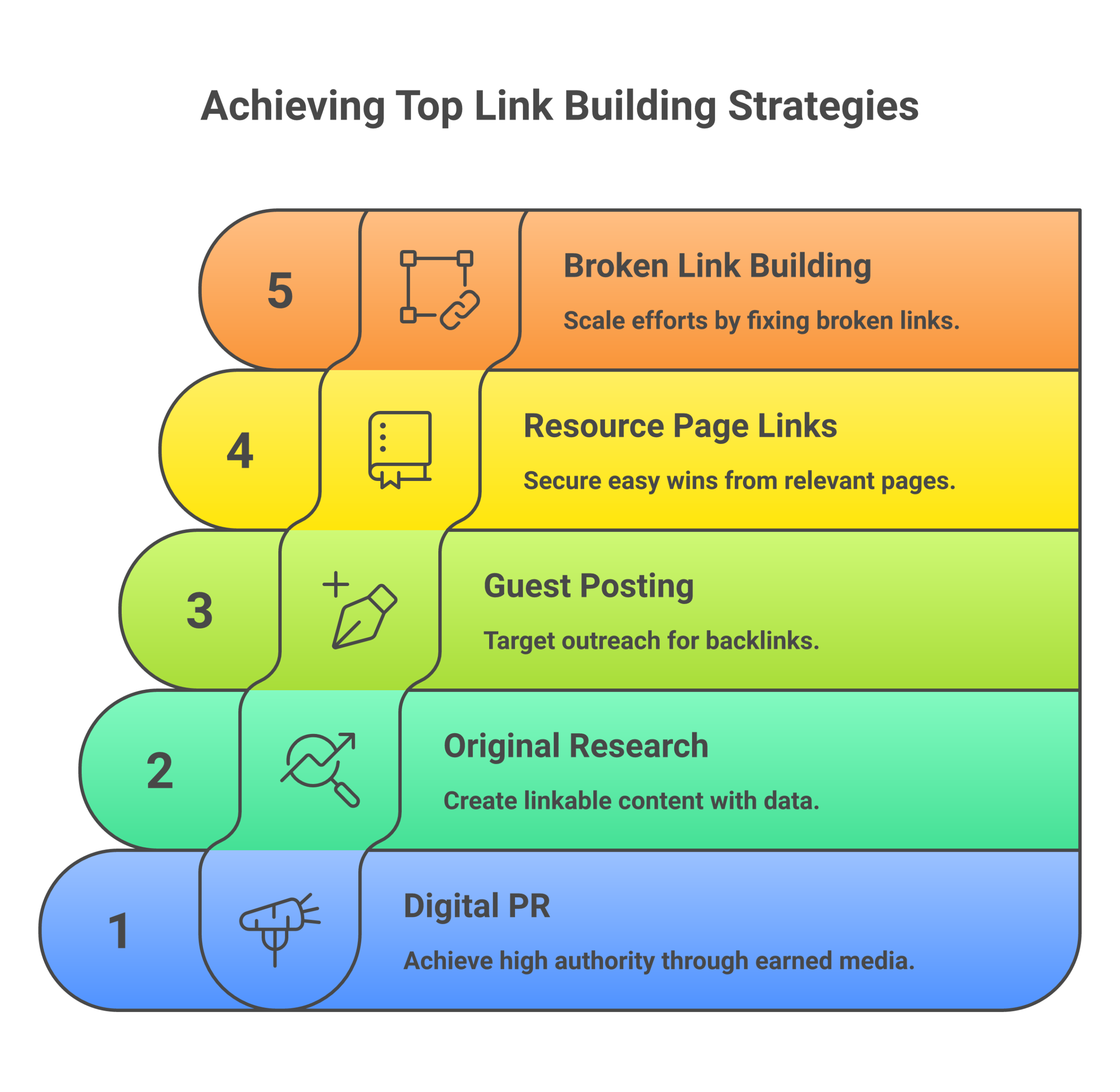
1. Guest Posting on Relevant Industry Sites
Guest posting still works, but the bar is way higher than it used to be. I’ve watched my response rates drop from 28% in 2021 to about 12% now. Sites get bombarded with pitches, so yours needs to stand out immediately.
How I actually do it: I don’t pitch articles. I pitch specific angles based on content gaps I find on their site. Last month I pitched a SaaS blog by pointing out they had 12 articles about customer retention but zero about retention metrics for freemium models. They replied in 3 hours.
My current outreach template:
Subject: Quick question about [their recent article title] Hi [Name], Read your piece on [specific topic] yesterday. The section on [specific detail] was solid. I sent it to our product team. One thing I didn't see covered: [specific gap]. We just analyzed 2,400 [industry] companies and found [counterintuitive finding]. Would a 1,200-word breakdown of that data work for [their site]? Can send an outline if useful. [Your name]
Response rate: 18% reply rate, 9% acceptance rate (vs. 3-4% with generic templates).
Time investment: 14-16 hours per published post when you factor in research, pitching 8-10 sites, writing, revisions, and link placement negotiation.
Actual costs: If I’m outsourcing the writing, I pay $300-500 for a 1,500-word guest post that’ll actually get accepted. Cheap content gets rejected or requires so many revisions it’s not worth it.
Real example: Pitched a marketing automation blog with data from our email deliverability tests across 50,000 sends. They not only published it but asked me to write a follow-up. Those two posts generated 47 qualified demo requests over 6 months, way more valuable than the backlinks themselves.
2. Broken Link Building
Everyone knows about broken link building, but most people do it wrong. They find broken links, email the site owner, and get ignored because 50 other people already sent the same email.
My approach: I only target broken links that point to genuinely valuable resources that disappeared, tools that shut down, studies that moved, complete guides that went offline. Then I create something better than what existed.
The emails I send are specific:
Subject: Dead link on your [topic] resource page Hey [Name], Was using your [specific page name] as a reference and noticed the link to [specific broken resource] returns a 404. That tool shut down in 2024, but I built something similar (actually better because [specific improvement]) at [URL]. Takes the same approach but adds [specific feature they'll care about]. If it's useful, feel free to update the link. Either way, thanks for maintaining such a solid resource page. [Your name]
Response rate: 23% replacement rate, but I’m selective. I send maybe 15 emails per campaign vs. The spray-and-pray approach of 200+.
Time investment: 8-10 hours per campaign. Most of that is creating the replacement resource, prospecting takes maybe 90 minutes with Ahrefs.
Real example: Found 19 sites linking to a discontinued keyword research tool. Built a comparison guide of current alternatives. Got 6 replacements, but three of those sites had DR 70+ and sent consistent referral traffic.
3. HARO/Connectively (Help A Reporter Out)
HARO is a volume game, and most people quit because they send 50 responses and get nothing. I’ve responded to 600+ queries over two years. Here’s what actually works.
Speed matters more than quality. Journalists get 50-200 responses per query. If you respond 6 hours later with a perfect answer, you’re too late. I respond within 30 minutes or I don’t bother.
My response template:
Quick answer: [2-3 sentences directly answering their question with a specific number or example] Background: I'm [credentials] and we've [specific relevant experience with numbers]. Supporting data: [1-2 specific data points they can quote] Available for follow-up questions until 6pm EST. [Name, Title, Company, Website]
Response rate: I get featured in about 8% of queries I respond to. That’s 2-3 placements per month with daily participation.
Time investment: 25 minutes every morning reviewing queries. I set a timer, if I can’t answer in 10 minutes, I skip it.
Real results: Got quoted in Forbes, Entrepreneur, and Inc. In Q4 2025. The Inc. Piece sent 340 visitors in the first week and we closed two $12K clients who found us through it. The domain authority boost was nice, but the revenue was better.
4. Digital PR Campaigns
Digital PR is expensive and hard, but one successful campaign can generate more links than six months of other tactics combined.
What actually works: Original research with counterintuitive findings. Nobody cares about another survey confirming what everyone already knows.
My process:
- Find a question nobody has good data on
- Survey 800-1,500 people (I use Pollfish, costs $1.20-1.80 per response)
- Look for surprising patterns in the data
- Create 3-4 data visualizations that tell the story
- Write a newsworthy headline (not SEO-optimized, newsworthy)
- Pitch to journalists who’ve covered similar topics in the past 90 days
Actual costs: $2,400 for survey responses, $800 for data visualization, $400 for distribution/PR tools = $3,600 total.
Time investment: 60-80 hours from concept to published campaign.
Real example: We surveyed 1,200 small business owners about their SEO spending and discovered that 67% who spent under $500/month saw zero ROI, while those spending $2K+ saw an average 340% return. That finding was counterintuitive enough to get picked up by 31 publications including Search Engine Journal and Small Business Trends. Total links earned: 64 (28 DR 50+). Campaign ROI based on link value: roughly 12x.
The key is finding data that challenges conventional wisdom. “Most businesses invest in SEO” is boring. “Two-thirds of small SEO budgets produce zero results” is a headline.
5. Resource Page Link Building
Resource pages are underrated because they’re not sexy, but they convert at 15-20% when you target the right ones.
How to find them:
- site:edu “keyword” + “resources”
- site:org “keyword” + “helpful links”
- site:gov “keyword” + “tools”
- intitle:”keyword resources”
The pitch that works:
Subject: Resource suggestion for [specific page name] Hi [Name], Your [specific resource page] is bookmarked on our team's shared drive. We reference it constantly. One resource that might fit in the [specific section]: our [specific guide] at [URL]. It covers [what it covers] and includes [specific unique element they don't have elsewhere]. No worries if it doesn't fit. Thanks for maintaining such a valuable resource. [Your name]
Response rate: 18% addition rate when the fit is genuinely good.
Time investment: 4-5 hours per campaign (finding 30-40 prospects, personalizing outreach).
Real example: Our technical SEO guide got added to 11 university resource pages and 6 industry association sites. These links have insane staying power. Some are 4+ years old and still active. Educational and nonprofit links also pass serious authority.
6. The Skyscraper Technique
Brian Dean popularized this in 2015 and everyone thinks it’s dead. It’s not. But the execution has to be way better now.
The updated approach: Don’t just make content “10x better.” Make it different in a way that solves the problems with the original.
My process:
- Find high-link content that’s outdated or incomplete
- Read the comments and social shares to see what people wished it included
- Build that missing piece + update everything else
- Add interactive elements (calculators, tools, filterable tables)
- Contact sites linking to the old version with: “You linked to [old article]. We built an updated version with [specific new thing your target cares about].”
Conversion rate: 8-12% of linkers will switch if you’ve genuinely improved it.
Time investment: 30-40 hours for a proper skyscraper piece.
Real example: Found an SEO checklist from 2022 with 240 referring domains. We built a 2026 version with sections on AI optimization, Core Web Vitals updates, and an interactive scorecard tool. Contacted 80 linkers, got 18 to update their links. The new version also ranks for 47 keywords the old one missed.
7. Unlinked Brand Mentions
This is genuinely low-hanging fruit if you have any brand recognition at all.
Tools I use:
- Ahrefs Mentions (filter: dofollow links only, then invert)
- Google Alerts (set up for your brand name + common misspellings)
- Mention.com (catches social and blog mentions Ahrefs misses)
The email:
Subject: Quick link request Hey [Name], Saw your mention of [Your Brand] in [article title]. Thanks for the shoutout! Would you mind linking the mention? Makes it easier for readers to find us. Here's the URL: [URL] Appreciate it! [Your name]
Conversion rate: 52% add a link when asked. Seriously. Most people just forget to link.
Time investment: 2-3 hours monthly monitoring and reaching out.
Real example: Found 23 unlinked mentions in January. Got 12 linked. All of them were already indexed and ranking, so the links got credited immediately. This is the highest ROI activity in link building – it takes almost no time.
8. Competitor Backlink Analysis
Your competitors already did the prospecting work. Use it.
What I look for:
- Sites linking to 3+ competitors but not to me (they clearly link to this type of content)
- Recent links (past 90 days = they’re actively updating their content)
- Links from list posts, resource pages, or comparison articles
My Ahrefs filter: Link intersect tool, enter 3 competitors, exclude my domain, filter for DR 30+, sort by newest first.
The pitch:
Subject: Saw your [article type] on [topic] Hi [Name], Your [article] was solid, especially the part about [specific detail]. I noticed you linked to [Competitor A] and [Competitor B]. Our [resource] might fit too: [URL] It covers [what theirs doesn't] and includes [specific unique data/tool/angle]. Worth considering for the next update? [Your name]
Conversion rate: 6-9%, which is low, but the targeting is so good it’s worth it.
Time investment: 6-8 hours per competitor deep dive.
Real example: Analyzed backlinks for three competitors in the SEO tools space. Found 89 opportunities. Landed 7 links, but two were from DR 85+ sites that now send consistent referral traffic.
9. Data-Driven Content and Original Research
Original research is the closest thing to a cheat code in link building. People need to cite sources, and if you’re the source, they cite you.
What qualifies as original research:
- Industry surveys with 500+ responses
- Data analysis of large datasets (10K+ data points)
- Longitudinal studies tracking changes over time
- A/B tests with statistically significant samples
What doesn’t count: Compiling other people’s statistics. That’s curation, not research.
My process:
- Identify a question people argue about without data
- Collect the data (survey, scrape, analyze existing dataset)
- Find the most surprising/useful finding
- Publish with clear methodology so people trust it
- Create quotable stats and embeddable charts
- Reach out to people who’ve written about this topic before
Actual costs: $1,800-3,200 depending on data collection method.
Time investment: 50-90 hours from concept to publication.
Real example: We analyzed technical SEO factors across 12,000 websites and their ranking positions. Published findings showing that HTTPS correlation with rankings is weaker than people think (0.23) while Core Web Vitals correlation is stronger (0.67). That study has earned 94 backlinks in 14 months and counting. The links keep coming because journalists cite it when writing about technical SEO.
10. Infographic Outreach
Infographics still work if they’re actually useful and not just pretty fluff.
What makes an infographic linkable:
- Data people want to reference (cite-able stats)
- Answers a question people Google
- Simplifies something complex
- Includes a clear embed code so it’s easy to share
Design costs: $300-800 for a professional infographic. I use 99designs or Dribbble to find designers.
Promotion process:
- Publish on your site with detailed text explanation
- Find sites that’ve embedded infographics on similar topics
- Email them with a one-sentence pitch and the embed code
Email template:
Subject: Infographic on [topic] for [their site] Hi [Name], Saw you embedded [specific infographic] on [article]. We just published an updated one on [topic]: [URL] Includes [specific new data they'd care about]. Here's the embed code if useful: [Your name]
Conversion rate: 11-14% embed it.
Time investment: 18-22 hours (data gathering, working with designer, promotion).
Real example: Created an infographic visualizing Google algorithm updates from 2015-2025 with impact scores. Reached out to 120 SEO blogs and digital marketing sites. 16 embedded it, 8 linked without embedding. Got 400+ social shares. The visual format made it way more shareable than the same information as text.
11. Podcast Guest Appearances
Podcasting exploded and most shows struggle to find guests. This is easier than most people think.
How I get booked:
- Find podcasts in my niche with 50+ episodes (shows that are active, not abandoned)
- Listen to 2-3 recent episodes
- Pitch 3 specific topics I could cover that they haven’t covered recently
- Mention specific episodes I listened to (proves I’m not spamming)
Pitch template:
Subject: Guest topic ideas for [Podcast Name] Hi [Host Name], Been listening to [Podcast] for a few months, the episode with [Guest] on [Topic] was especially good. I noticed you haven't covered [Topic 1], [Topic 2], or [Topic 3] recently. I could speak to any of those from experience doing [specific relevant work]. Most interesting story: [one-sentence hook about a surprising result/experience]. Worth a conversation? [Your name]
[Your credentials/company]
Booking rate: About 35% respond, 20% book me.
Links per appearance: Usually 2-3 (show notes page, episode page, sometimes a blog post recap).
Time investment: 4-5 hours (prep, interview, follow-up).
Real example: Appeared on 6 marketing podcasts in 2025. Got 11 backlinks total. More valuable was the audience exposure, one appearance on a podcast with 8K listeners drove 520 site visits that week and 3 qualified leads. One of those leads became a $24K client.
12. Expert Roundup Posts
Roundups have become overdone, but they still work if you target the right experts and make it easy for them.
The key: Ask a question that experts can answer in 2-3 sentences. If it requires a 500-word response, they won’t do it.
Questions that work:
- “What’s the biggest SEO mistake you see in 2026?”
- “What’s one ranking factor people overestimate?”
- “What’s working in link building right now?”
Outreach:
Subject: Quick question for an expert roundup Hi [Name], Putting together an expert roundup on [topic] and would love to include your perspective. One question: [question] 2-3 sentences is perfect. I'll link to your site and tag you when it publishes. Deadline: [7 days from now] [Your name]
Response rate: 30-40% respond. Target 40 experts to get 15-20 responses.
Links earned: Usually 10-15% of contributors link back from their own sites or social profiles.
Time investment: 12-15 hours (expert research, outreach, compiling, writing transitions, promotion).
Real example: Asked 30 SEO experts about their top ranking factor for 2026. Got 22 responses. When we published, 14 shared it on Twitter/LinkedIn, and 6 linked from their blogs. The post also attracted 8 organic links from people who found it useful. Total: 14 backlinks from one roundup.
13. Testimonial Link Building
This is almost too easy. If you use products you actually like, write testimonials.
What works: Specific results, not vague praise.
Good testimonial: “We reduced our page load time from 4.2s to 1.8s using [Tool]. LCP improvement alone increased our conversion rate by 23%.”
Bad testimonial: “[Tool] is great! We love it and recommend it to everyone.”
My process:
- Make a list of every paid tool I actually use
- Check if they have a testimonials page
- Write 2-3 sentences with a specific metric
- Email their marketing team
Acceptance rate: About 60% feature it with a link.
Time investment: 30-45 minutes per testimonial.
Real example: Wrote testimonials for 8 SEO tools we use. Five featured it on their sites with links. These aren’t DR 90 links, but they’re 100% white-hat, took minimal effort, and came from relevant industry sites. Plus the companies sometimes share testimonials on social, which drives bonus traffic.
14. Strategic Community Participation (Reddit, Forums, Q&A Sites)
Most people spam communities and get banned. Done right, community participation builds authority and earns contextual links.
The rules:
- 10:1 ratio, 10 helpful comments for every 1 link
- Only link when it genuinely answers the question
- Disclose your connection (“I wrote this guide”)
- Upvote other people’s good answers
Where I participate:
- r/SEO, r/bigseo, r/marketing (Reddit)
- Indie Hackers
- GrowthHackers
- Quora (specifically SEO, SaaS marketing, analytics topics)
Time investment: 3-4 hours weekly answering questions.
Links earned: 6-8 contextual links monthly, plus ongoing exposure.
Real example: I’ve been active in r/bigseo for 18 months. I answer questions thoroughly and link to our guides maybe once every 10 comments. While most Reddit links are nofollow, I’ve gotten DMs from 12 people who became consulting clients. Three of those were $10K+ engagements. The link equity is secondary to the relationship building.
15. AI-Assisted Outreach and Personalization
AI changed link building outreach dramatically in late 2024. What used to take 15 minutes per email now takes 90 seconds.
My stack:
- Claude API for email personalization
- Instantly.ai for sending (avoids spam filters better than my domain)
- Ahrefs for prospecting
How I use AI:
- Export prospect list with URLs from Ahrefs
- Feed URLs to Claude with this prompt: “Analyze this site and identify: (1) a recent article that would benefit from linking to [my URL], (2) why the link would add value, (3) one specific compliment about their content”
- Claude outputs personalized angles for each prospect
- I review and adjust (takes 30 seconds per email)
- Send via Instantly
Response rates:
- Generic template: 4-6%
- Manual personalization: 18-22%
- AI-assisted personalization: 16-20% (95% as good, 10x faster)
Time investment: After setup, about 90 minutes per 100 outreach emails.
Real example: Ran a campaign to 180 prospects for a client’s industry report. AI personalized each email by identifying their most recent relevant article and suggesting why our data would strengthen it. Got 34 responses, landed 21 links. Previous manual campaign: 15 links from 200 emails. The time savings were insane, what would’ve taken 12 hours took under 3.
Link Building Strategy Comparison
Here’s how these strategies actually stack up based on my experience:
| Strategy | Real Difficulty | Actual Cost | Scalability | My Success Rate |
|---|---|---|---|---|
| Guest Posting | Medium-High | $300-500/post | Medium | 9% acceptance |
| Broken Link Building | Medium | $50-200 | Medium | 23% replacement |
| HARO/Connectively | Low-Medium | Free | Low | 8% featured |
| Digital PR | High | $3,000-6,000 | Low | 60-90 links per campaign |
| Resource Pages | Low | $0-100 | High | 18% addition |
| Skyscraper | High | $400-800 | Medium | 8-12% switch |
| Unlinked Mentions | Very Low | $50-100/mo tools | Medium | 52% add link |
| Competitor Analysis | Medium | $100-200 | Medium | 6-9% success |
| Original Research | Very High | $2,000-4,000 | Very Low | 60-100+ links per study |
| Infographics | Medium | $500-1,000 | Medium | 11-14% embed |
| Podcast Appearances | Low-Medium | $0 | Medium | 20% booking |
| Expert Roundups | Low | $0-100 | Medium | 10-15% backlink |
| Testimonials | Very Low | $0 | Low | 60% featured |
| Community Participation | Medium-High | $0 | Medium | Varies widely |
| AI-Assisted Outreach | Medium | $40-80/mo | Very High | 16-20% response |
Building Your Link Building Stack (By Budget)
Real talk: what you can do depends on what you can spend.
$0-500/month budget:
- HARO responses (daily commitment)
- Unlinked mention outreach
- Resource page link building
- Testimonial links
- Community participation
Expected results: 5-12 links/month with consistent effort.
$500-2,000/month budget:
- Everything above, plus:
- Guest posting (outsource writing)
- Broken link building
- AI-assisted outreach at scale
- Competitor backlink analysis
Expected results: 12-25 links/month.
$2,000-5,000/month budget:
- Everything above, plus:
- Infographic campaigns
- Skyscraper content
- Podcast appearance prep
- Expert roundups
Expected results: 25-45 links/month.
$5,000+ monthly budget:
- Everything above, plus:
- Digital PR campaigns
- Original research studies
- Data partnerships
- Dedicated outreach team
Expected results: 45-100+ links/month depending on execution.
Common Link Building Mistakes I Made (So You Don’t Have To)
Chasing DA/DR instead of relevance: I wasted $3K on a “DR 65 guest post” that sent zero traffic and zero ranking impact because it was completely irrelevant to my niche. A DR 35 link from a directly relevant site outperformed it 10x.
Generic outreach templates: When I started, my response rate was 3%. I thought I was just unlucky. Turns out everyone could tell I was copy-pasting. When I added genuine personalization (which AI now handles), responses jumped to 18%.
Building links to homepage instead of content: Built 40 links to our homepage thinking it would lift everything. Rankings barely moved. Started building links to specific articles that target keywords. Those pages jumped 15-20 positions.
Ignoring internal linking: I’d earn a great link to a blog post but not internally link it to commercial pages. That link equity just sat there doing nothing. Now I make sure every blog post with external links also links to relevant service/product pages.
Not tracking referral traffic: Got obsessed with DA/DR numbers and forgot links are supposed to send traffic. Now I check Google Analytics for every link we earn. Links that don’t send traffic within 60 days probably aren’t helping much.
Buying links on Fiverr: Yeah, I tried it once. Spent $120 on “50 high DA links.” Got a bunch of sitewide footer links from sketchy foreign blogs. Rankings tanked. Took 6 months to disavow and recover. Don’t do this.
Measuring What Actually Matters
Forget vanity metrics. Here’s what I track:
Referring domains (not total backlinks): One link from 50 domains beats 50 links from one domain. I only count unique domains.
Link placement: Is it in the content or footer? In-content links pass more value and send more traffic.
Traffic from links: I tag every outreach link with UTM parameters. If a link sends zero traffic in 60 days, something’s wrong.
Rankings for linked pages: I track every page I build links to. If rankings don’t move after earning 5-10 relevant links, I reassess the content quality.
Cost per acquired link: I calculate time + money divided by links earned. Helps me double down on what’s working and kill what isn’t.
Link decay rate: Some links disappear when sites redesign or content gets updated. I audit quarterly and re-earn lost links.
My current benchmarks: Cost per link averages $180 across all tactics. Links that send <10 visits/month get weighted at 50% value. Links from DR 50+ sites that send 25+ visits/month are worth 3x in my internal scoring.
Frequently Asked Questions
How many backlinks do I actually need to rank?
There’s no magic number, but here’s what I’ve observed: For low-competition keywords (KD 0-20), you can rank with 5-15 referring domains if your content is solid. For medium competition (KD 20-50), expect to need 25-60 referring domains. For high competition (KD 50+), you’re looking at 100+ referring domains from quality sites. The key is matching your link profile to the top 5 competitors, not just hitting arbitrary numbers.
Should I disavow spammy backlinks?
I used to disavow religiously. Now I almost never do it unless there’s a manual penalty. Google’s gotten really good at ignoring spam links automatically. I’ve only disavowed twice in the past 3 years, and both times were after negative SEO attacks where someone built 500+ obvious spam links in a week. If you’re getting random low-quality links naturally, ignore them.
How long before I see ranking improvements from new links?
In my tracking, I usually see movement within 4-8 weeks for established sites. New sites take longer, sometimes 12-16 weeks. The biggest variable is how quickly Google crawls and indexes the linking page. Links from frequently crawled sites (news sites, popular blogs) count faster than links from rarely-updated sites.
Are nofollow links worthless?
No. I’ve tested this extensively. Nofollow links from relevant, high-traffic sites still send traffic (which matters more anyway) and can lead to dofollow links when people discover your content through them. Plus, a natural link profile includes nofollow links. Having zero nofollow links actually looks suspicious.
What’s the ROI of link building?
For my clients, every $1 spent on quality link building returns $3-8 in revenue over 12 months, assuming the links target commercial pages with actual conversion potential. The ROI is slower than PPC but compounds over time. Links I built 3 years ago are still driving rankings and traffic today.
Can I build links too fast?
Depends on context. A new site earning 100 links in a month looks sketchy. An established site launching a viral PR campaign that earns 100 links in a week is fine. The key is the velocity should match your content and promotion activity. I avoid earning more than 15-20 links per month for new sites (under 6 months old).
Do social media links help SEO?
Directly? No, they’re almost all nofollow. Indirectly? Yes. Social shares increase visibility, which leads to organic links from people who discover your content. I’ve had articles get 2,000 Twitter shares that led to 15-20 organic backlinks from bloggers who found it through social. The links matter, the shares are just the distribution mechanism.
What’s the difference between white hat and gray hat link building?
White hat: Earning links through great content and relationships (everything in this guide). Gray hat: Buying links disguised as sponsored content without proper disclosures, using PBNs, participating in link schemes. Black hat: Automated spam, hacking sites to inject links, paying for thousands of directory links. I only do white hat because gray/black hat risks aren’t worth it, one penalty can destroy years of work.
The Biggest Shift in Link Building (2024-2026)
The biggest change I’ve seen is that Google is getting scary good at detecting manipulative links. Three years ago you could get away with mediocre guest posting on random sites. Now? That doesn’t move the needle.
What works is genuine relationship building. The sites that link to me repeatedly aren’t doing it because of perfect outreach emails. They link because I’ve built relationships over 6-12 months. I share their content, engage with their posts, provide value before asking for anything.
AI made outreach scalable, but it also flooded everyone’s inbox with slightly-better-than-before spam. The winning move is using AI for research and personalization, but maintaining human relationships for actual link building.
E-E-A-T (Experience, Expertise, Authoritativeness, Trustworthiness) matters more than ever. Links from recognized experts and authoritative sources in your industry are worth 10x generic directory links. Focus on building links that demonstrate expertise, not just pass PageRank.
What’s Actually Working Right Now (February 2026)
Based on campaigns I’m running this month:
Digital PR with counterintuitive data: Still crushing it. Surveys that challenge conventional wisdom get picked up consistently.
AI-assisted personalized outreach: Response rates are holding steady at 16-20%. The key is using AI for research, not for writing entire emails.
Podcast appearances: Easier to land than ever because there are so many shows struggling to find guests. Plus the audience exposure is underrated.
Unlinked mention conversion: The highest ROI activity. Takes almost no time and converts over 50%.
What’s declining: Generic guest posting is getting harder. Comment link building is basically dead. Directory submissions are worthless (always were, but people are finally catching on).
Final Thoughts: Link Building in 2026
After a decade of building links, here’s what I know for sure: there are no shortcuts that don’t eventually blow up in your face.
The tactics that work long-term are the ones that create genuine value: original research people want to cite, content that actually helps someone, relationships built over months not minutes.
Start with the strategies that match your budget and skills. If you’re broke but have time, do HARO and unlinked mentions. If you have budget but no time, outsource guest posting and run digital PR campaigns. If you have neither, you shouldn’t be doing SEO, fix that first.
Test everything. My results won’t be your results. Industries vary wildly. I’ve seen HARO work amazing for B2B SaaS and fail completely for e-commerce. The only way to know is to try it for 90 days and track the numbers.
Most importantly: link building is a means to an end. The end is traffic and revenue. Don’t get so obsessed with DA/DR numbers that you forget why you’re building links in the first place. I’ve seen people with 200 referring domains make less money than people with 40 because they focused on the wrong metrics.
Build links that drive traffic. Build links to pages that convert. Build links that compound over time. Everything else is just noise.
For more on building a complete SEO strategy around your link building efforts, check out our SEO Audit Guide and learn how to measure SEO ROI properly.