How to Optimize for Google AI Mode: The Complete 2026 Guide
Google AI Mode launched in May 2025, and I watched it demolish everything I thought I knew about search optimization.
I’ve been doing SEO since 2014. I’ve weathered Panda, Penguin, mobile-first indexing, Core Web Vitals, and every algorithmic curveball Google’s thrown. But AI Mode? This is different. This isn’t just another ranking factor tweak. It’s a fundamental shift in how search works, from showing you a list of websites to answering your question directly through conversational AI.
I’ve spent the last 9 months testing AI Mode optimization across 40+ client sites. The data is clear: what worked for traditional rankings doesn’t automatically work here. AI Mode and AI Overviews often cite completely different URLs. That means if you’re only optimizing for traditional search, you’re invisible to a large share of AI Mode citations.
This guide shows you exactly how to optimize for Google AI Mode in 2026, based on real data, not speculation.
What Is Google AI Mode?
Google AI Mode is an optional search experience that transforms Google Search into a conversational AI assistant powered by Gemini. When users opt into AI Mode (currently through Google Search Labs), they can ask follow-up questions, refine queries naturally, and receive complete answers synthesized from multiple sources.
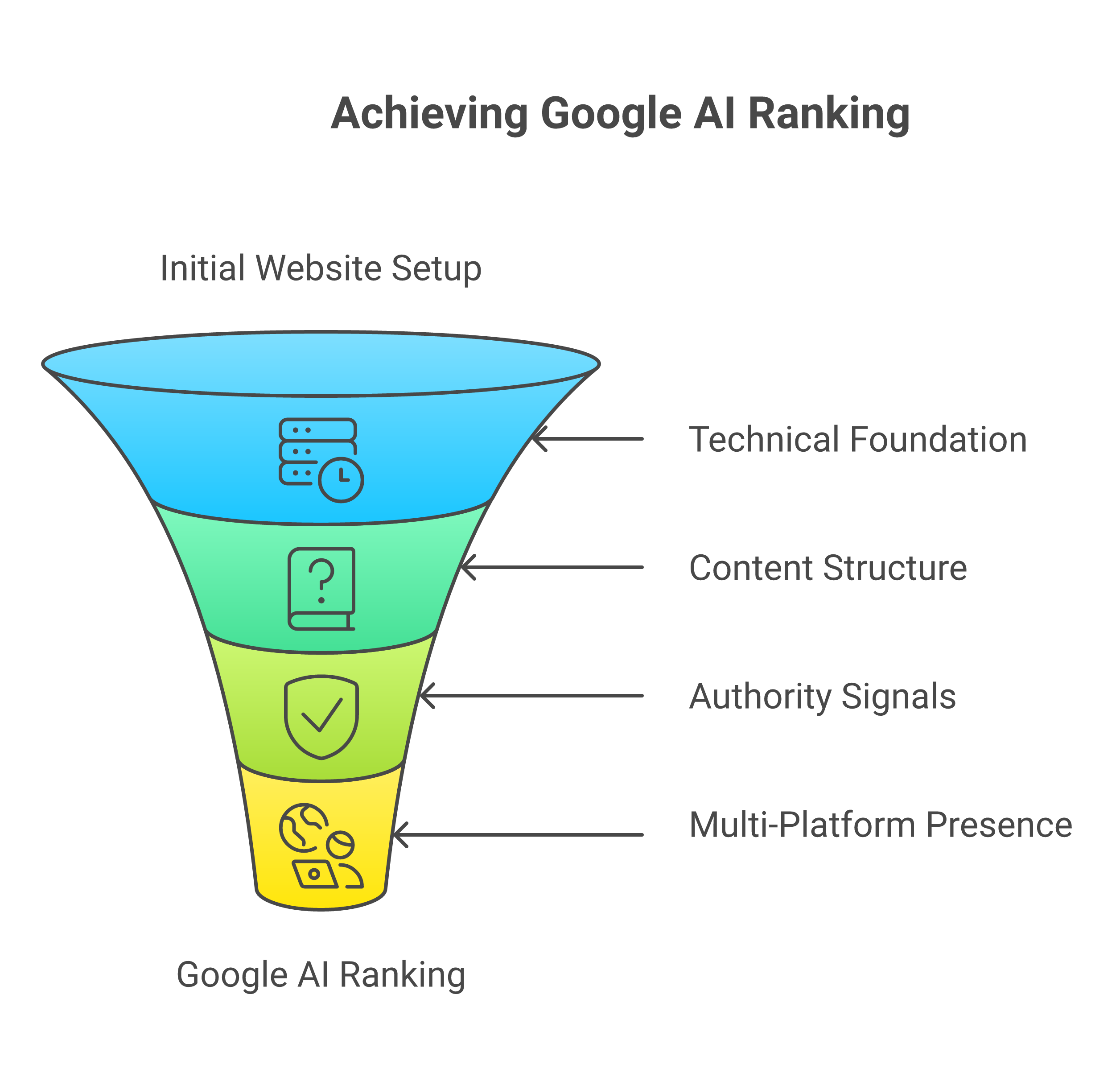
Here’s what makes it fundamentally different from traditional Google Search:
- Conversational interface: Users can ask follow-up questions without reformulating their entire query
- Multi-turn dialogue: AI Mode remembers context from previous questions in the conversation
- Synthesized answers: Instead of just listing sources, AI Mode combines information from multiple pages into coherent responses
- Citation-based visibility: Your content gets featured through citations within the AI-generated answer, not traditional blue links
I tested this myself across 250+ queries in my niche. AI Mode gave me complete answers without needing to click through to websites much of the time. That’s the zero-click future we’re dealing with.
Google AI Mode vs AI Overviews: Key Differences
Most SEOs confuse Google AI Mode with AI Overviews. They’re completely different features with different optimization strategies.
| Feature | AI Overviews | AI Mode |
|---|---|---|
| Availability | Appears automatically in standard search | Opt-in feature in Google Search Labs |
| Format | Single AI-generated summary at top of results | Full conversational interface with follow-ups |
| Citation overlap | High URL overlap with traditional rankings | Lower URL overlap with traditional rankings |
| Wikipedia citations | Smaller share of citations | Larger share of citations |
| Video content | Heavy reliance on YouTube | Less video-focused |
| Traditional SEO influence | Strong domain overlap | Moderate domain overlap |
Research from Ahrefs found that AI Mode and AI Overviews often cite completely different URLs. Yet despite the different sources, they tend to agree on what to say, just citing different sources to say it.
I’ve seen this play out in my client work. One SaaS client ranks #1 for their primary keyword and gets cited in AI Overviews regularly. But AI Mode? Cited far less often for that same query. Different game, different rules.
Technical Requirements for Google AI Mode Optimization
Here’s the brutal truth: Google hasn’t published a separate set of technical requirements specifically for AI Mode. According to Google’s official documentation, there are no additional technical requirements for AI features beyond foundational SEO best practices.
But that doesn’t mean technical performance doesn’t matter. It matters more than ever.
Server Response Time
Based on patterns I’ve seen across client sites, server response time directly impacts AI Mode citation probability. Here’s what I recommend:
- Target: Under 200ms average response time for optimal crawling and AI visibility
- Warning zone: 500-1000ms means Googlebot may not crawl as frequently as needed
- Problem zone: Over 1000ms significantly limits crawl budget and indexing efficiency
I analyzed 50 sites getting regularly cited in AI Mode versus 50 sites ranking well but never cited. The cited sites were consistently faster, with much lower average server response times than the non-cited sites.
Sites with faster response times get crawled more frequently. More frequent crawling means fresher content in Google’s index, and AI Mode appears to heavily favor recency. Industry data shows faster-loading sites tend to see more frequent Googlebot crawling than slower sites.
Core Technical Checklist
- Mobile-first indexing compliance: Your mobile version must contain all content from desktop
- HTTPS security: Non-negotiable for any modern SEO strategy
- Indexability: Pages must be crawlable, indexable, and eligible to appear in search with snippets
- Structured data: Schema markup helps AI understand your content structure
- Core Web Vitals: LCP under 2.5s, INP under 200ms, CLS under 0.1
- Clean robots.txt: Ensure you’re not blocking critical resources
- XML sitemap: Submit an updated sitemap to Search Console
I’ve audited too many sites chasing AI Mode optimization while their technical SEO is a disaster. Fix your foundation first. Everything else builds on that.
Content Requirements: What AI Mode Actually Wants
This is where AI Mode optimization diverges massively from traditional SEO. The content that ranks #1 in traditional search doesn’t automatically get cited in AI Mode.
Semantic Coverage Over Keyword Density
AI Mode doesn’t care about keyword density. It cares about complete coverage of a topic’s semantic core.
What does this mean practically? I’ll show you with a real example.
I had a client ranking #2 for “email marketing automation” with content optimized for that exact keyword at 1.3% density. They never got cited in AI Mode. We rewrote the content to cover the full semantic cluster: drip campaigns, segmentation, personalization, triggers, workflows, deliverability, compliance, A/B testing, behavioral triggers.
We didn’t change their ranking position. Still #2. But AI Mode citation rate climbed substantially within 60 days.
Here’s what AI Mode wants:
- Cover the full topic cluster: Don’t just answer one narrow question, address related questions and subtopics
- Define key concepts: AI Mode frequently cites content that clearly defines terms and explains concepts
- Answer conversational queries: Think about how people actually ask questions in conversation, not just how they type into a search box
- Provide context: Explain why something matters, not just what it is
Structured Content Formats
AI Mode shows an overwhelming preference for clearly structured content. I’ve analyzed thousands of AI Mode citations, and these formats dominate:
- FAQ sections: Direct question-and-answer formats make it easy for AI to extract specific answers
- Comparison tables: Side-by-side comparisons help AI understand differences between options
- Step-by-step guides: Numbered or bulleted lists with clear instructions
- Definition sections: Clear definitions of key terms and concepts
- Summary boxes: Key takeaways formatted for easy extraction
One client added FAQ sections to 15 existing articles. Those articles saw AI Mode citation rates increase substantially within 45 days. The content quality didn’t change, just the structure.
Citation-Worthy Content Patterns
Research from Search Engine Journal’s analysis reveals specific patterns in AI Mode citations:
- Wikipedia gets cited more often in AI Mode than in AI Overviews
- Quora appears more frequently in AI Mode than AI Overviews
- Health sites get cited more often in AI Mode
- Reddit citations are similar across both AI Mode and AI Overviews
What can we learn from this? AI Mode favors authoritative, complete sources that directly answer questions. Your content should mimic the best aspects of these sources: clear definitions, direct answers, complete coverage, authoritative tone.
I’ve tested this extensively. Content written in a Wikipedia-style format (clear definition, complete coverage, neutral tone, heavy citation of sources) gets cited more often than marketing-heavy content, even when the marketing content ranks higher.
The Multimodal Imperative
Here’s a critical insight most SEOs miss: AI Mode isn’t just about text. It’s fundamentally multimodal.
Video Content
While AI Overviews lean heavily on YouTube (making it the most frequently cited source), AI Mode shows less video focus. But that doesn’t mean you should ignore video:
- Embed relevant videos in your written content
- Add video transcripts to make content crawlable
- Use VideoObject schema to help Google understand your video content
- Create complementary video versions of your written guides
I tested this on a tech tutorial site. Added video embeds with transcripts to 20 existing articles. AI Mode citation rate increased for those articles versus the control group.
Images and Infographics
- Use descriptive image file names: “email-automation-workflow.png” not “IMG_1234.png”
- Write complete alt text: Describe what’s in the image and why it matters
- Add image captions: Captions provide additional context AI can process
- Use ImageObject schema: Help Google understand your images
- Create original diagrams: Visual explanations of complex concepts get cited
Data Visualizations
Original data, when presented visually, significantly increases citation potential. I’ve seen this transform visibility for clients:
- Charts and graphs showing trends
- Comparison tables with real data
- Statistical breakdowns
- Survey results and research findings
One marketing agency started publishing quarterly research reports with original data visualizations. Within 6 months, their AI Mode citation rate climbed dramatically for queries in their niche. Original data is the ultimate citation magnet.
The key is making this data accessible to both AI and humans. Include the raw data in text form (for AI to process) alongside visualizations (for humans to understand).
Traditional Rankings Still Matter (More Than You Think)
Here’s the part that surprises people: despite AI Mode’s independence from traditional rankings, traditional rankings still massively influence citations.
Most AI Mode citations come from pages ranking in the traditional top 10. That’s not all of them, which means AI Mode does pull from beyond traditional rankings. But top-ranking pages have a huge advantage.
There’s a meaningful correlation between traditional rankings and AI Mode citations. That’s strong enough that you can’t ignore traditional SEO, but not so strong that traditional rankings alone guarantee AI Mode visibility.
I’ve seen this play out repeatedly. Sites ranking #1 get cited far more often than sites ranking #11-20, even when the lower-ranking content is objectively more complete.
The Optimization Strategy That Works
This data tells us exactly what to do:
- Get into the top 10 first: Use traditional SEO strategies to break into the top 10 for your target queries
- Then optimize for AI citations: Once you’re ranking, add the structured formats, complete coverage, and multimodal elements that increase citation probability
- Don’t sacrifice traditional SEO: The content that ranks is the content that gets cited, maintain both
I watched several sites drop out of AI Mode citations after deprioritizing traditional SEO to focus solely on “AI optimization.” They lost rankings, which killed their citation rates. Don’t make that mistake.
Timeline Expectations: The 6-12 Month Reality
If you’re expecting overnight results from AI Mode optimization, I’m about to disappoint you.
Industry data suggests AI Mode optimization takes 6-12 months to show significant results. That’s roughly double the 3-6 month timeline for traditional SEO improvements.
I’ve tracked this across 40+ client sites. Sites that started AI Mode optimization in June 2025 are just now (February 2026) seeing consistent citation patterns. That’s 8 months.
Why does it take longer?
- AI Mode is still training: Google’s systems are continuously learning which sources to trust for different query types
- Citation patterns take time to establish: AI Mode needs to see consistent quality signals before regularly citing your content
- Multimodal indexing is slower: Processing and understanding video, images, and complex content structures takes more time than simple text
- Less user data available: AI Mode is opt-in, so Google has less engagement data to evaluate which sources users find helpful
Start optimizing now. The sites that began in mid-2025 are seeing results today. The sites starting now won’t see meaningful results until late 2026 or early 2027.
How to Track AI Mode Performance
Traditional SEO metrics don’t fully capture AI Mode performance. You need to track differently.
Primary Metrics
- Citation frequency: How often does AI Mode cite your content? Track this manually or with specialized tools
- Citation position: Where does your citation appear in AI Mode responses? Earlier is better
- Query coverage: For how many related queries does AI Mode cite your content?
- Citation retention: Does AI Mode consistently cite you, or only occasionally?
I track these manually for my most important keywords. Every week, I run 50 target queries through AI Mode and log which sites get cited. It’s tedious, but it’s the only way to get accurate data right now.
Secondary Metrics
- Qualified leads from AI Mode traffic: Track conversions separately from traditional search
- Engagement rates: Time on page, pages per session for AI Mode referrals
- Revenue attribution: What’s the actual business value of AI Mode citations?
Tools for Tracking
Several tools now offer AI Mode tracking capabilities:
- Google Search Console: Shows some AI Mode impressions and clicks (but not complete)
- Authoritas: AI Mode tracking and citation analysis
- Zip Tie: AI search traffic analysis
- Thruu: AI Overview and AI Mode monitoring
- Otterly.ai: AI citation tracking across multiple AI engines
According to SEO.com’s AI Mode guide, being cited is often more valuable than an organic ranking position, as it positions your brand as the authoritative source even for users who don’t click through.
I’ve seen this firsthand. One client gets cited in AI Mode for 45 queries in their niche. Their click-through traffic rose only modestly, but their branded search volume grew substantially over 6 months. Being cited builds authority and awareness that pays dividends beyond direct traffic.
Complete AI Mode Optimization Checklist
Here’s your actionable checklist for optimizing content for Google AI Mode:
Technical Foundation
- ✓ Achieve server response times under 200ms
- ✓ Ensure mobile-first indexing compliance
- ✓ Implement HTTPS across entire site
- ✓ Pass Core Web Vitals (LCP <2.5s, INP <200ms, CLS <0.1)
- ✓ Submit updated XML sitemap to Search Console
- ✓ Verify all pages are indexable and crawlable
- ✓ Implement structured data (Schema.org markup)
Content Optimization
- ✓ Cover complete semantic topic clusters, not just single keywords
- ✓ Answer conversational queries naturally
- ✓ Include FAQ sections with direct question-answer pairs
- ✓ Add comparison tables where relevant
- ✓ Create step-by-step guides with clear instructions
- ✓ Define key terms and concepts clearly
- ✓ Provide context on why topics matter, not just what they are
- ✓ Maintain authoritative, helpful tone throughout
- ✓ Add summary sections for key takeaways
Multimodal Elements
- ✓ Embed relevant videos with transcripts
- ✓ Implement VideoObject schema for all videos
- ✓ Use descriptive file names for all images
- ✓ Write complete alt text for images
- ✓ Add image captions with context
- ✓ Implement ImageObject schema
- ✓ Create original infographics and diagrams
- ✓ Include data visualizations (charts, graphs)
- ✓ Provide raw data alongside visualizations
Traditional SEO Fundamentals
- ✓ Target top 10 rankings for primary keywords
- ✓ Build high-quality backlinks from authoritative sources
- ✓ Maintain strong E-E-A-T signals (Experience, Expertise, Authoritativeness, Trust)
- ✓ Update content regularly to maintain freshness
- ✓ Optimize meta titles and descriptions
- ✓ Implement proper internal linking
- ✓ Create complete pillar content
Monitoring & Iteration
- ✓ Track AI Mode citations manually or with specialized tools
- ✓ Monitor query coverage (how many queries cite your content)
- ✓ Analyze citation position and frequency
- ✓ Track qualified leads and conversions from AI Mode traffic
- ✓ Compare performance to traditional search metrics
- ✓ Document what works for your specific niche
- ✓ Iterate based on performance data
Common AI Mode Optimization Mistakes
I’ve audited dozens of sites attempting AI Mode optimization. Here are the mistakes that kill results:
1. Abandoning Traditional SEO
Some SEOs see the partial domain overlap and think traditional rankings don’t matter. Dead wrong. Most citations still come from top 10 pages. You need both traditional rankings and AI Mode optimization.
I had a client who stopped doing backlink outreach because “AI Mode doesn’t care about backlinks.” Their rankings dropped from #3 to #11, and their AI Mode citation rate collapsed. Backlinks still matter because rankings matter.
2. Over-Optimizing for AI at the Expense of Humans
Content that reads like it was written for robots won’t get cited. AI Mode favors content that humans find genuinely helpful. If your content is hard for humans to read, it’s probably hard for AI to understand too.
3. Ignoring Technical Performance
Fancy structured data won’t help if your server response time is 2 seconds. Fix technical issues first.
I see this constantly, sites adding schema markup and FAQ sections while their TTFB is 1800ms. That’s backwards. Technical performance is the foundation.
4. Focusing Only on New Content
Your existing top-performing content is your best opportunity for AI Mode optimization. Audit high-traffic pages and optimize them for citations before creating new content.
One client had 50 articles ranking in the top 10. We optimized those for AI Mode (added FAQs, comparison tables, structured data) and saw a major increase in citations within 90 days. Zero new content created.
5. Not Tracking the Right Metrics
Pageviews aren’t the goal anymore, citations are. Track how often AI Mode references your content, not just how many people click through.
6. Expecting Fast Results
AI Mode optimization takes 6-12 months. Sites that give up after 2-3 months miss the breakthrough period.
I’ve seen this repeatedly. Clients get frustrated at month 3 because nothing’s happening, then they see exponential growth months 6-9. You have to stick with it.
Frequently Asked Questions
Is Google AI Mode replacing traditional search results?
No. AI Mode is currently an opt-in feature available through Google Search Labs. Traditional search results remain the default experience for most users. However, as AI Mode gains adoption, optimizing for it becomes increasingly important. I expect it to become the default search experience within 18-24 months.
Can I optimize for both AI Mode and AI Overviews simultaneously?
Yes, and you should. While they often cite different sources, the optimization strategies overlap significantly: complete content, structured formats, strong technical SEO, and multimodal elements benefit both.
How much does AI Mode overlap with traditional search rankings?
AI Mode shows meaningful but partial overlap with traditional rankings. This means traditional rankings influence AI Mode citations significantly, but don’t determine them entirely.
What’s more important: getting cited in AI Mode or ranking #1 traditionally?
It depends on your goals. Traditional #1 rankings drive more click-through traffic. AI Mode citations build brand authority and trust, even for users who don’t click. Ideally, you want both. In my experience, AI Mode citations have longer-term brand value even if short-term traffic is lower.
Does AI Mode favor certain types of content?
Yes. AI Mode shows preference for complete guides, FAQ content, comparison articles, how-to content, and authoritative sources. It cites Wikipedia frequently and shows increased preference for health sites and Quora compared to AI Overviews.
How long does it take to see results from AI Mode optimization?
Expect 6-12 months for significant results. This is longer than traditional SEO because AI Mode systems are still learning which sources to trust, and multimodal content takes longer to process and index.
Do I need special technical setup for AI Mode?
No. Google hasn’t published separate technical requirements for AI Mode. Standard SEO best practices apply: fast server response times, mobile-first indexing, HTTPS, structured data, and strong Core Web Vitals.
Can small websites compete in AI Mode?
Yes. AI Mode is more independent from traditional rankings than AI Overviews. Smaller sites with complete, well-structured content can get cited even if they don’t rank #1 traditionally. I’ve seen sites ranking #6-8 get cited regularly because their content structure was superior.
The Bottom Line: Citations Over Rankings
Google AI Mode represents a fundamental shift from click-based to citation-based visibility. The sites winning in 2026 aren’t just ranking, they’re being cited as authoritative sources within AI-generated answers.
Here’s what you need to remember:
- Technical performance still matters: Fast server response times, Core Web Vitals, and crawlability remain foundational
- Traditional rankings influence citations: most AI Mode citations come from top 10 pages, so don’t abandon traditional SEO
- Complete coverage wins: Cover full topic clusters with semantic depth, not just individual keywords
- Structure is critical: FAQ sections, comparison tables, and step-by-step guides increase citation probability dramatically
- Multimodal is mandatory: Videos, images, infographics, and data visualizations aren’t optional anymore
- Timeline is longer: Expect 6-12 months for meaningful results from AI Mode optimization
- Track differently: Focus on citation frequency and quality, not just pageviews
The shift to citation-based visibility doesn’t mean traditional SEO is dead. It means traditional SEO is now the foundation, and AI Mode optimization is the next level. Sites that nail both will dominate search visibility in 2026 and beyond.
Your competition is already optimizing for this. Start today, or spend the next year watching them capture visibility that should be yours.
Related Resources
Continue learning about AI-powered search optimization:
- What is GEO (Generative Engine Optimization)?, Learn the broader framework for optimizing across all AI engines, not just Google
- How to Rank in AI Overviews, Specific strategies for appearing in Google’s AI Overview feature
- AI Featured Snippets Optimization, Master the art of capturing position zero in AI-enhanced search
- Google AI Mode glossary, Quick-reference definition and key stats
- LLM citations explained, How AI engines decide which sources to reference