

As we navigate through 2026, schema markup has evolved from a “nice-to-have” SEO tactic into an absolute necessity for anyone serious about search visibility. With Google’s ranking in AI overviews dominating informational queries, ChatGPT and Perplexity reshaping how users find information, and traditional SERPs becoming increasingly competitive, structured data has become the universal language that bridges human content and machine understanding.
This complete guide will walk you through everything you need to know about schema markup in 2026—from the fundamentals to advanced implementation strategies that can multiply your visibility in both traditional search and AI-powered answer engines.
What is Schema Markup?
Schema markup is a form of structured data—standardized code you add to your website’s HTML—that helps search engines understand your content more effectively. Think of it as translating your webpage from human language into a format that machines can read, interpret, and present more intelligently.
Created through a collaboration between Google, Bing, Yahoo, and Yandex, Schema.org provides a shared vocabulary of tags that webmasters can use to markup their pages. This structured data uses key-value pairs to define entities (people, places, things, events) and their relationships, transforming unstructured content into machine-readable data.
When you add schema markup to your pages, you’re essentially providing search engines with explicit clues about what your content means, not just what it says. Instead of algorithms having to guess whether “Apple” refers to a fruit or a technology company, your markup tells them directly.
Why Schema Markup Matters for SEO in 2026
The importance of schema markup has reached unprecedented levels in 2026, driven by three major shifts in the search landscape:
Enhanced Visibility in Traditional Search
Websites with properly implemented structured data see click-through rate improvements of 20-30% compared to standard listings, according to industry studies. The primary benefit lies in schema’s ability to trigger rich results—enhanced SERP displays that include star ratings, price information, availability status, event dates, recipe cooking times, and other compelling details that make your listing stand out.
While Google has stated that schema markup is not a direct ranking factor, the indirect benefits are undeniable. Rich results occupy more visual real estate, appear more trustworthy, and provide users with immediate answers—all factors that dramatically improve click-through rates and, consequently, your overall SEO performance.
Critical for AI Citations and Generative Engine Optimization (GEO)
In 2026, Generative Engine Optimization (GEO) has emerged as a discipline that complements traditional SEO. Where SEO aims for clicks to your site, GEO optimizes your chances of being cited directly in AI-generated responses from ChatGPT, Google’s AI Overviews, Perplexity, and other answer engines.
Research shows that properly structured content with schema markup achieves 2.5x higher AI visibility compared to unstructured content. The most advanced AI systems rely on Knowledge Graphs—structured databases that connect entities and their relationships—and Schema.org data directly feeds these graphs.
When AI systems need to understand, verify, and cite information, they gravitate toward content that explicitly defines its entities, relationships, and context. Schema markup provides exactly that. Companies that have adopted AI SEO strategies are already seeing up to 20% of their traffic come from large language models.
Competitive Necessity
As of 2026, schema markup implementation has become table stakes. Your competitors are using it, and search engines increasingly favor websites that speak their language. Not implementing schema means you’re essentially showing up to a conversation without the ability to communicate effectively—you’ll be understood less, trusted less, and featured less.
For more context on how structured data fits into the broader evolution of search, see our guide on Generative Engine Optimization.
Essential Schema Types for SEO
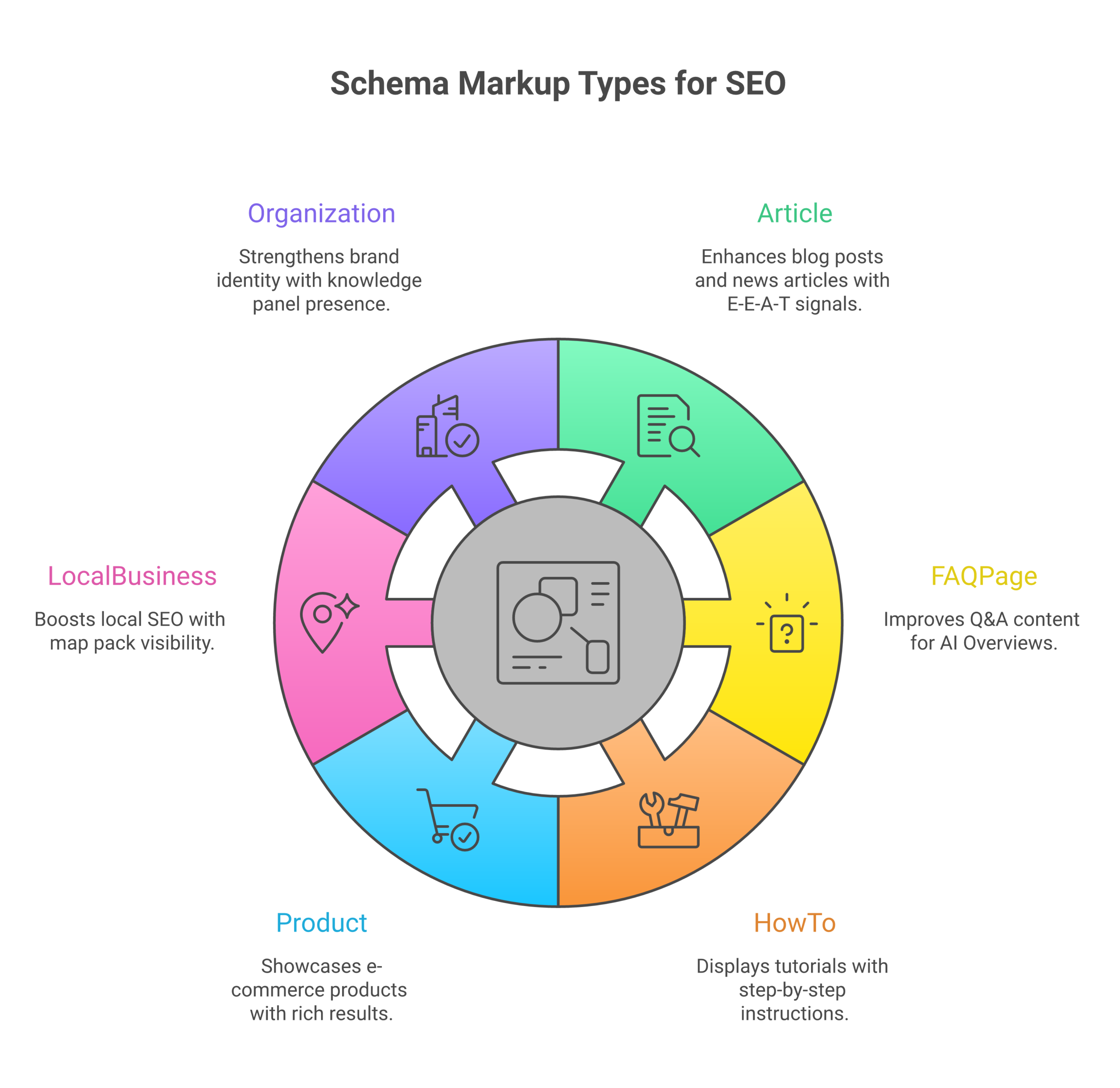
Schema.org defines hundreds of types and thousands of properties, but most websites will focus on a core set that delivers the highest SEO impact. Here are the most important schema types you need to know in 2026:
Article Schema
Article schema is essential for blog posts, news articles, and editorial content. It helps search engines understand publication dates, authors, and content structure—all critical for establishing topical authority and freshness signals.
Key properties: headline, datePublished, dateModified, author, publisher, image, articleBody
When to use: Blog posts, news articles, guides, case studies
{
  "@context": "https://schema.org",
  "@type": "Article",
  "headline": "Schema Markup for SEO: The Complete Guide to Structured Data (2026)",
  "datePublished": "2026-02-07T09:00:00+00:00",
  "dateModified": "2026-02-07T09:00:00+00:00",
  "author": {
    "@type": "Person",
    "name": "Dr. Matt",
    "url": "https://atlasmarketing.ai/about/"
  },
  "publisher": {
    "@type": "Organization",
    "name": "Atlas Marketing",
    "logo": {
      "@type": "ImageObject",
      "url": "https://atlasmarketing.ai/logo.png"
    }
  },
  "image": "https://atlasmarketing.ai/images/schema-markup-guide.jpg",
  "articleBody": "Full article text here..."
}
Product Schema
Product schema is critical for ecommerce SEO guide sites. It enables rich product listings with prices, availability, ratings, and reviews—all factors that dramatically improve click-through rates for commercial searches.
Key properties: name, image, description, brand, offers (price, priceCurrency, availability), aggregateRating, review
When to use: Product pages, e-commerce listings
{
  "@context": "https://schema.org",
  "@type": "Product",
  "name": "Professional SEO audit guide Service",
  "image": "https://atlasmarketing.ai/images/seo-audit.jpg",
  "description": "Comprehensive technical SEO guide audit with actionable recommendations",
  "brand": {
    "@type": "Organization",
    "name": "Atlas Marketing"
  },
  "offers": {
    "@type": "Offer",
    "url": "https://atlasmarketing.ai/services/seo-audit/",
    "priceCurrency": "USD",
    "price": "997",
    "availability": "https://schema.org/InStock"
  },
  "aggregateRating": {
    "@type": "AggregateRating",
    "ratingValue": "4.9",
    "reviewCount": "127"
  }
}
FAQ Schema
FAQ schema is one of the most powerful types for capturing featured snippet positions. It structures your questions and answers in a way that makes them perfect for both traditional search results and AI-generated responses.
Key properties: mainEntity (array of Question objects with name and acceptedAnswer)
When to use: FAQ sections, help documentation, Q&A content
{
  "@context": "https://schema.org",
  "@type": "FAQPage",
  "mainEntity": [
    {
      "@type": "Question",
      "name": "What is schema markup?",
      "acceptedAnswer": {
        "@type": "Answer",
        "text": "Schema markup is structured data code added to your website that helps search engines understand your content more effectively. It uses a standardized vocabulary from Schema.org to transform unstructured content into machine-readable format."
      }
    },
    {
      "@type": "Question",
      "name": "Is schema markup a ranking factor?",
      "acceptedAnswer": {
        "@type": "Answer",
        "text": "While schema markup is not a direct ranking factor according to Google, it significantly impacts SEO through improved click-through rates from rich results, better content understanding by search engines, and increased visibility in AI-powered answer engines."
      }
    }
  ]
}
HowTo Schema
HowTo schema structures step-by-step instructions in a format that search engines love. It’s particularly effective for tutorial content and can trigger rich results that show your steps directly in the SERP.
Key properties: name, step (array with name, text, image), totalTime, tool, supply
When to use: Tutorials, DIY guides, instructional content
{
  "@context": "https://schema.org",
  "@type": "HowTo",
  "name": "How to Implement Schema Markup",
  "totalTime": "PT30M",
  "step": [
    {
      "@type": "HowToStep",
      "name": "Choose Your Schema Type",
      "text": "Identify which schema type best matches your content—Article, Product, FAQ, HowTo, or LocalBusiness.",
      "url": "https://atlasmarketing.ai/schema-markup-guide/#choose-schema-type"
    },
    {
      "@type": "HowToStep",
      "name": "Generate JSON-LD Code",
      "text": "Use Google's Structured Data Markup Helper or a schema generator to create your JSON-LD code.",
      "url": "https://atlasmarketing.ai/schema-markup-guide/#generate-code"
    },
    {
      "@type": "HowToStep",
      "name": "Add Code to Your Page",
      "text": "Insert the JSON-LD code within script tags in your page's HTML, typically in the head or footer section.",
      "url": "https://atlasmarketing.ai/schema-markup-guide/#add-code"
    }
  ]
}
LocalBusiness Schema
LocalBusiness schema is essential for any business with a physical location. It helps you appear in local search results, Google Maps, and voice search queries for nearby businesses.
Key properties: name, address, geo (latitude/longitude), openingHours, telephone, priceRange, aggregateRating
When to use: Local business websites, stores, restaurants, service providers with physical locations
{
  "@context": "https://schema.org",
  "@type": "LocalBusiness",
  "name": "Atlas Marketing SEO Agency",
  "image": "https://atlasmarketing.ai/storefront.jpg",
  "address": {
    "@type": "PostalAddress",
    "streetAddress": "123 SEO Street",
    "addressLocality": "New York",
    "addressRegion": "NY",
    "postalCode": "10001",
    "addressCountry": "US"
  },
  "geo": {
    "@type": "GeoCoordinates",
    "latitude": "40.7128",
    "longitude": "-74.0060"
  },
  "telephone": "+1-555-123-4567",
  "openingHoursSpecification": [
    {
      "@type": "OpeningHoursSpecification",
      "dayOfWeek": ["Monday", "Tuesday", "Wednesday", "Thursday", "Friday"],
      "opens": "09:00",
      "closes": "17:00"
    }
  ],
  "priceRange": "$$$"
}
Person Schema
Person schema establishes you as an entity in search engines’ knowledge graphs. This is crucial for personal branding, author authority, and E-E-A-T (Experience, Expertise, Authoritativeness, Trustworthiness) signals.
Key properties: name, jobTitle, worksFor, url, sameAs (social profiles), image
When to use: Author bio pages, about pages, personal websites
{
  "@context": "https://schema.org",
  "@type": "Person",
  "name": "Dr. Matt",
  "jobTitle": "SEO Strategist & AI Content Specialist",
  "worksFor": {
    "@type": "Organization",
    "name": "Atlas Marketing"
  },
  "url": "https://atlasmarketing.ai/about/",
  "sameAs": [
    "https://twitter.com/atlasmarketingseo",
    "https://linkedin.com/in/atlasmarketingseo"
  ],
  "image": "https://atlasmarketing.ai/author-photo.jpg",
  "alumniOf": {
    "@type": "Organization",
    "name": "University Name"
  }
}
Organization Schema
Organization schema defines your business entity, establishing your brand in search engines’ knowledge graphs. This foundational schema type should be on every website’s homepage.
Key properties: name, url, logo, contactPoint, sameAs, address, founder
When to use: Homepage, about page
{
  "@context": "https://schema.org",
  "@type": "Organization",
  "name": "Atlas Marketing",
  "url": "https://atlasmarketing.ai",
  "logo": "https://atlasmarketing.ai/logo.png",
  "description": "Elite SEO and AI content optimization services",
  "founder": {
    "@type": "Person",
    "name": "Dr. Matt"
  },
  "contactPoint": {
    "@type": "ContactPoint",
    "telephone": "+1-555-123-4567",
    "contactType": "Customer Service",
    "email": "atlasmarketingseo@gmail.com"
  },
  "sameAs": [
    "https://twitter.com/atlasmarketing",
    "https://linkedin.com/company/atlasmarketing",
    "https://facebook.com/atlasmarketing"
  ]
}
Review Schema
Review schema displays star ratings and review counts directly in search results, dramatically improving click-through rates for products, services, and local businesses.
Key properties: itemReviewed, author, reviewRating, datePublished
When to use: Product reviews, service reviews, testimonials
{
  "@context": "https://schema.org",
  "@type": "Review",
  "itemReviewed": {
    "@type": "Service",
    "name": "SEO Audit Service"
  },
  "author": {
    "@type": "Person",
    "name": "Sarah Johnson"
  },
  "reviewRating": {
    "@type": "Rating",
    "ratingValue": "5",
    "bestRating": "5"
  },
  "datePublished": "2026-01-15",
  "reviewBody": "Atlas Marketing's SEO audit uncovered critical technical issues we didn't know existed. Within 60 days of implementing their recommendations, our organic traffic increased by 127%."
}
Event Schema
Event schema is crucial for conferences, webinars, workshops, and any time-specific happenings. It enables your events to appear in Google’s event search features and rich results.
Key properties: name, startDate, endDate, location, organizer, offers
When to use: Event pages, webinar registrations, conference listings
{
  "@context": "https://schema.org",
  "@type": "Event",
  "name": "Advanced SEO Strategies for 2026",
  "startDate": "2026-03-15T10:00:00-05:00",
  "endDate": "2026-03-15T16:00:00-05:00",
  "eventStatus": "https://schema.org/EventScheduled",
  "eventAttendanceMode": "https://schema.org/OnlineEventAttendanceMode",
  "location": {
    "@type": "VirtualLocation",
    "url": "https://atlasmarketing.ai/webinar"
  },
  "organizer": {
    "@type": "Organization",
    "name": "Atlas Marketing",
    "url": "https://atlasmarketing.ai"
  },
  "offers": {
    "@type": "Offer",
    "url": "https://atlasmarketing.ai/webinar-registration",
    "price": "0",
    "priceCurrency": "USD",
    "availability": "https://schema.org/InStock",
    "validFrom": "2026-02-01T00:00:00-05:00"
  }
}
BreadcrumbList Schema
BreadcrumbList schema shows your site hierarchy in search results, helping users understand page context and improving internal linking signals. Google displays these breadcrumbs in place of URLs in search results.
Key properties: itemListElement (array of ListItem objects with position, name, item)
When to use: All pages with hierarchical navigation
{
  "@context": "https://schema.org",
  "@type": "BreadcrumbList",
  "itemListElement": [
    {
      "@type": "ListItem",
      "position": 1,
      "name": "Home",
      "item": "https://atlasmarketing.ai"
    },
    {
      "@type": "ListItem",
      "position": 2,
      "name": "SEO Guides",
      "item": "https://atlasmarketing.ai/seo-guides/"
    },
    {
      "@type": "ListItem",
      "position": 3,
      "name": "Schema Markup Guide",
      "item": "https://atlasmarketing.ai/schema-markup-guide/"
    }
  ]
}
JSON-LD: The Recommended Format
While schema markup can be implemented using three different formats—Microdata, RDFa, and JSON-LD—Google explicitly recommends JSON-LD (JavaScript Object Notation for Linked Data) as the preferred method in 2026.
Why JSON-LD is Superior
JSON-LD offers several critical advantages over other formats:
- Separation of concerns: JSON-LD lives in script tags completely separate from your HTML markup, meaning you can add, modify, or remove structured data without touching your visible page content.
- Easier implementation: You can add JSON-LD to your pages without modifying existing HTML structure or learning special attribute syntax.
- Maintenance friendly: Updating structured data doesn’t require hunting through HTML—all your schema markup lives in one clean, centralized location.
- Validation friendly: JSON-LD’s clean structure makes it easier to validate and debug using Google’s testing tools.
- Dynamic generation: JSON-LD can be easily generated programmatically from databases or CMS fields.
Where to Place JSON-LD Code
JSON-LD can be placed anywhere in your HTML document—in the <head> or <body> sections. Most developers place it in the <head> for organizational reasons, but search engines will find and parse it regardless of location.
<!DOCTYPE html>
<html>
<head>
  <title>Your Page Title</title>
  <script type="application/ld+json">
  {
    "@context": "https://schema.org",
    "@type": "Article",
    "headline": "Your Article Title"
  }
  </script>
</head>
<body>
  Your page content here
</body>
</html>
How to Implement Schema Markup
Implementation complexity varies depending on your technical setup, but the process generally follows these steps:
For WordPress Sites (Easiest)
WordPress users have multiple options for implementing schema markup:
Option 1: Use an SEO Plugin
- Yoast SEO: Automatically adds basic Organization, Person, and Article schema. Premium version offers more control.
- Rank Math: Excellent schema implementation with support for all major types. Free version is quite comprehensive.
- All in One SEO: Solid schema features with visual schema builder in premium version.
Option 2: Use a Dedicated Schema Plugin
- Schema Pro: Most comprehensive dedicated schema plugin with support for 20+ schema types.
- WP Schema Pro: User-friendly interface for non-technical users.
- Schema & Structured Data for WP: Free option with good variety of schema types.
Option 3: Add Custom Code
For maximum control, add JSON-LD directly to your theme’s header.php or use a custom plugin to inject schema based on post type, category, or other conditions.
For Custom Websites
If you’re working with a custom-built site, you’ll need to:
- Identify which pages need which schema types based on content type
- Generate JSON-LD code using Google’s Structured Data Markup Helper or schema generators
- Add the code to your templates in script tags with
type="application/ld+json" - Use dynamic variables to populate schema properties from your database/CMS
- Test thoroughly before deploying to production
For E-commerce Platforms
Most major e-commerce platforms offer built-in schema support or apps:
- Shopify: Includes basic Product schema out of the box. Apps like JSON-LD for SEO provide enhanced control.
- WooCommerce: Basic Product schema included. Rank Math or Yoast provide enhanced schema options.
- BigCommerce: Built-in Product and Organization schema with ability to customize via Page Builder.
For a broader technical SEO perspective on implementation, check our Complete Technical SEO Guide.
Testing and Validating Your Schema Markup
Implementation is only half the battle—proper testing ensures your schema markup is error-free and eligible for rich results.
Google Rich Results Test
The Google Rich Results Test (search.google.com/test/rich-results) is your primary testing tool. It shows you:
- Which rich result types your page is eligible for
- Preview of how your rich results will appear in search
- Errors and warnings in your structured data
- Mobile rendering of rich results
Simply enter your URL or paste your code to get instant feedback. Fix all errors before publishing, and address warnings when possible (warnings won’t prevent rich results but may reduce their effectiveness).
Schema Markup Validator
The Schema Markup Validator (validator.schema.org) provides more technical validation against Schema.org standards. Use this tool to:
- Validate JSON-LD syntax
- Check for required properties you might have missed
- Verify relationships between nested schema types
- Ensure proper use of Schema.org vocabulary
This validator is stricter than Google’s tools and will catch technical issues that might not prevent rich results but could cause problems with other search engines or future Google updates.
Google Search Console
After deploying schema markup, monitor its performance in Google Search Console under the “Enhancements” section. You’ll see:
- Which pages have valid structured data
- Errors or warnings that need fixing
- Rich result performance (impressions and clicks)
- Historical trends showing schema health over time
Check Search Console weekly for the first month after implementation, then monthly thereafter. Google may discover issues that weren’t apparent in pre-deployment testing.
Testing Checklist
Before marking your schema implementation complete, verify:
- All required properties are present for each schema type
- URLs are absolute (include https://domain.com) not relative (/page/)
- Dates follow ISO 8601 format (YYYY-MM-DD or YYYY-MM-DDTHH:MM:SS)
- Images meet minimum size requirements (1200px wide for most types)
- No HTML markup within schema properties (plain text only)
- JSON syntax is valid (no trailing commas, proper quote usage)
- Schema matches visible page content (no misleading information)
Common Schema Markup Mistakes (And How to Avoid Them)
After analyzing hundreds of websites, certain schema mistakes appear repeatedly. Here are the most common pitfalls and how to avoid them:
1. Missing Required Properties
The mistake: Implementing schema types without all required properties. For example, adding Product schema without an image, or Review schema without a rating.
The fix: Always consult the official Schema.org documentation for each type you implement. Google’s structured data documentation also lists required properties for rich result eligibility. Use validators to catch missing requirements.
2. Mismatched Content
The mistake: Schema markup that doesn’t match visible page content. For example, showing 5-star reviews in schema when the page only displays 3-star reviews, or marking up content that doesn’t exist on the page.
The fix: Schema must reflect actual page content. Google may penalize pages with misleading structured data. If your markup shows it, your page must display it.
3. Multiple Competing Schemas
The mistake: Having multiple plugins or methods all adding schema markup, creating duplicates or conflicts. This commonly happens when switching from one SEO plugin to another without properly cleaning up.
The fix: Audit your source code to identify all schema sources. Disable duplicate implementations. Use only one method per page to add each schema type.
4. Incorrect Date Formats
The mistake: Using date formats like “January 5, 2026” or “01/05/2026” instead of ISO 8601 format.
The fix: Always use ISO 8601 format: YYYY-MM-DD for dates (2026-01-05) or YYYY-MM-DDTHH:MM:SS+00:00 for date-times (2026-01-05T14:30:00+00:00).
5. Relative URLs Instead of Absolute
The mistake: Using relative URLs like “/about/” instead of absolute URLs like “https://yourdomain.com/about/”.
The fix: All URLs in schema markup must be fully-qualified absolute URLs including protocol (https://) and domain. This ensures proper entity resolution across the web.
6. HTML in Text Properties
The mistake: Including HTML markup within schema text properties, such as "headline": "<h1>My Article Title</h1>".
The fix: Schema properties should contain plain text only, with HTML tags stripped. The exception is properties specifically designed for HTML content, which are rare.
7. Overly Aggressive Implementation
The mistake: Adding every possible schema type to every page, creating bloated markup that confuses rather than clarifies.
The fix: Be strategic. Each page should have schema types that match its primary purpose. A blog post needs Article schema, not Product schema. A product page needs Product schema, not Event schema. Quality and relevance beat quantity.
8. Neglecting Updates
The mistake: Implementing schema once and never updating it, even when page content changes significantly.
The fix: Review and update schema markup when content changes. Particularly important for dateModified, offers (prices), availability, ratings, and event dates. Stale schema can trigger rich result removal.
Schema Markup for AI Citations: GEO Optimization
One of the most significant developments in 2026 is the role schema markup plays in getting your content cited by AI systems like ChatGPT, Google AI Overviews, Perplexity, and other generative engines.
Why AI Systems Prefer Structured Data
Large language models and optimizing for Google AI Mode engines don’t just scrape text—they build understanding through Knowledge Graphs. These graphs are structured databases that connect entities and their relationships. Schema.org markup directly feeds these graphs, making your content significantly more “AI-readable.”
Research shows that content with proper schema markup achieves 2.5x higher visibility in AI-generated responses compared to unstructured content. This makes schema markup not just an SEO tactic, but a critical component of your broader content distribution strategy.
Priority Schema Types for GEO
While all schema types help with AI understanding, certain types are particularly valuable for generative engine optimization:
- FAQPage: Directly answers questions, making it perfect for AI systems looking to provide comprehensive responses
- HowTo: Step-by-step instructions are frequently cited by AI when users ask “how to” questions
- Article: Establishes content authority, freshness, and authorship—all signals AI systems use to evaluate source quality
- Organization & Person: Builds entity authority and helps AI systems attribute information to credible sources
- Review: Provides social proof that AI systems can reference when recommending products or services
GEO Schema Best Practices
To maximize your chances of being cited by AI systems:
- Include explicit entity definitions: Use Organization, Person, and Thing types to clearly define all entities mentioned in your content
- Connect entities through relationships: Use properties like “author”, “publisher”, “about”, and “mentions” to map entity relationships
- Provide comprehensive properties: Don’t just include required fields—add optional properties that give AI systems richer context
- Keep content fresh: Update dateModified regularly. AI systems strongly prefer recent content—76.4% of AI-cited pages were updated within 30 days
- Add sameAs properties: Link entities to authoritative external sources (Wikipedia, Wikidata, official social profiles) to build credibility
For comprehensive strategies on optimizing for AI citations, see our complete guide on Generative Engine Optimization.
WordPress Plugins for Schema Markup
While manual implementation offers maximum control, WordPress plugins provide user-friendly interfaces that make schema markup accessible to non-technical users. Here are the leading options in 2026:
Rank Math (Recommended)
Rank Math has emerged as the most comprehensive free SEO plugin with exceptional schema support. It includes:
- Support for 15+ schema types including Article, Product, Course, Recipe, FAQ, How-To, and more
- Automatic schema generation based on content type
- Visual schema builder for custom implementations
- Google Structured Data testing integration
- Schema preview showing how your markup will appear
The free version covers most use cases, making Rank Math the best value proposition for WordPress users serious about schema markup.
Yoast SEO
As the most popular WordPress SEO plugin, Yoast includes basic schema support in its free version:
- Automatic Organization and Person schema
- Article schema for blog posts
- Breadcrumb schema
- WebPage schema
Yoast Premium adds more schema types and customization options, though it’s less comprehensive than Rank Math’s free version for schema specifically.
Schema Pro
Schema Pro is a dedicated schema plugin that doesn’t try to be a complete SEO solution. It focuses exclusively on structured data:
- Support for 20+ schema types
- Custom schema builder
- Conditional display rules
- Repeater fields for complex schemas
- WooCommerce integration
Schema Pro is ideal if you already use a different SEO plugin but want more advanced schema capabilities.
All in One SEO
AIOSEO’s schema implementation has improved significantly:
- Smart schema generator that auto-detects content types
- Visual schema editor
- FAQ and How-To schema blocks
- Local business schema with multiple location support
The free version covers basics, while premium unlocks advanced schema types and e-commerce integration.
Schema Markup and Core Web Vitals
An often-overlooked consideration is the impact of schema markup on page speed and Core Web Vitals. While structured data is essential, implementation matters:
JSON-LD Performance Impact
JSON-LD schema markup has minimal impact on page load times because:
- It’s typically 2-10KB of code—negligible compared to images, CSS, and JavaScript
- Browsers parse it quickly since it’s simple JSON
- It doesn’t trigger additional HTTP requests
- It doesn’t block rendering
However, excessive or poorly implemented schema can cause issues:
Best Practices for Performance
- Keep it lean: Only include schema types relevant to each page. Don’t add every possible type “just in case.”
- Minimize properties: Include required properties and key optional ones, but don’t stuff every possible property if it adds little value.
- Avoid redundancy: Ensure only one source is adding schema—multiple plugins all adding similar schema wastes bytes.
- Consider inline vs. separate file: For most sites, inline JSON-LD is fine. High-traffic sites might consider external JSON files with caching.
Advanced Schema Strategies
Once you’ve mastered basic implementation, these advanced strategies can give you an edge:
Schema Stacking
Combine multiple schema types on a single page when appropriate. For example, a blog post about an event could include:
- Article schema for the blog post itself
- Event schema for the event being discussed
- BreadcrumbList schema for navigation
- Person schema for the author
Each schema type lives in its own JSON-LD script block, providing layered context.
Dynamic Schema Generation
For sites with thousands of pages, manually managing schema is impractical. Implement dynamic generation that:
- Pulls data from your CMS database
- Auto-populates schema properties
- Updates automatically when content changes
- Applies consistent patterns across similar page types
Schema for Internal Link Structure
Use SiteNavigationElement and BreadcrumbList schemas to explicitly map your site architecture for search engines. This reinforces your internal linking strategy and helps search engines understand page relationships and hierarchy.
Schema for Competitive Differentiation
Look for schema types your competitors aren’t using. If you’re in a competitive niche where everyone has basic Article schema, adding comprehensive FAQ or HowTo schemas can give you the edge for featured snippets and rich results.
Monitoring Schema Performance
Implementation isn’t the end—ongoing monitoring ensures your schema continues delivering results:
Key Metrics to Track
- Rich result impressions: How often your enhanced listings appear in search (Google Search Console)
- Rich result clicks: How many clicks your rich results generate vs. standard listings
- CTR improvement: Compare CTR before and after schema implementation
- Schema coverage: Percentage of pages with valid structured data
- Error rate: Pages with schema errors or warnings (should be near zero)
- Featured snippet captures: Pages winning position zero after adding schema
Regular Maintenance Tasks
- Monthly: Review Google Search Console enhancements reports for errors
- Quarterly: Audit schema across your site to ensure consistency and accuracy
- After major updates: Re-test all schema when you redesign, migrate platforms, or change SEO plugins
- When Schema.org updates: Review official changelog and update to new standards
The Future of Schema Markup
Looking ahead, schema markup’s importance will only increase:
AI systems are multiplying: As more AI-powered search and answer engines emerge, structured data becomes the universal language for content understanding across platforms.
Schema vocabulary is expanding: Schema.org continuously adds new types and properties to cover emerging content formats and use cases.
Search engines are demanding more: Google and other search engines increasingly require structured data for advanced features. What’s optional today may become mandatory tomorrow.
Voice search dependence: Voice assistants rely heavily on structured data to answer spoken queries. As voice search grows, schema becomes even more critical.
Competitive necessity: As schema adoption reaches critical mass in your industry, not having it puts you at a significant disadvantage.
Frequently Asked Questions
Is schema markup a ranking factor?
Schema markup is not a direct ranking factor according to Google. However, it significantly impacts SEO through improved click-through rates from rich results, better content understanding by search engines, and increased visibility in AI-powered answer engines. These indirect benefits often lead to better rankings over time.
How long does it take for schema markup to work?
Google typically processes new schema markup within a few days to two weeks. You may see rich results appear in search results within this timeframe. However, the full impact on click-through rates and traffic can take 4-8 weeks to materialize as Google indexes your pages and begins displaying enhanced results consistently.
Can schema markup hurt my SEO?
Incorrectly implemented or misleading schema markup can result in manual actions or removal of rich results. However, properly implemented schema that accurately reflects your page content poses no risk. Always ensure your markup matches visible content and use Google’s testing tools to validate before publishing.
Do I need schema markup on every page?
Not every page needs schema markup, but most can benefit from it. At minimum, add Organization schema to your homepage, Article schema to blog posts, Product schema to product pages, and LocalBusiness schema if you have physical locations. The more pages with relevant schema, the better your overall site structure is communicated to search engines.
What’s the difference between schema markup and rich snippets?
Schema markup is the code you add to your pages, while rich snippets are the enhanced search results that may appear because of that code. Schema markup is the input; rich snippets are the potential output. Having schema markup doesn’t guarantee rich snippets—Google decides whether to display them based on various factors.
Should I use multiple schema types on one page?
Yes, when appropriate. A blog post can have Article schema, BreadcrumbList schema, Person schema for the author, and Organization schema for the publisher. Each should be in its own JSON-LD script block. Avoid redundancy—don’t add the same schema type twice on the same page.
How do I choose which schema type to use?
Choose schema types based on your page’s primary purpose and content. Ask: “What is this page fundamentally about?” A page about a product = Product schema. A page explaining a process = HowTo or Article schema. A page listing frequently asked questions = FAQPage schema. Match schema to content type, not desired outcome.
Can I test schema markup before publishing?
Yes. Use Google’s Rich Results Test and Schema Markup Validator to test your code before adding it to live pages. You can paste code directly into these tools without publishing. Fix all errors and warnings before deployment.
Final Thoughts: Making Schema Markup Part of Your SEO Workflow
Schema markup has evolved from an advanced SEO tactic to a fundamental requirement for search visibility in 2026. With the rise of AI-powered search, generative engines, and increasingly competitive SERPs, structured data provides the universal language that ensures your content is understood, indexed, and cited by both traditional search engines and AI systems.
The most successful approach treats schema markup as a standard part of your content publication workflow, not an afterthought. Every piece of content you publish should include appropriate structured data from day one. This ensures:
- Maximum visibility in traditional search results through rich snippets
- Higher likelihood of AI citations in ChatGPT, Perplexity, and Google AI Overviews
- Better communication of your site architecture and content relationships
- Stronger entity signals that build topical authority over time
Start with the basics—Organization schema on your homepage, Article schema on blog posts, Product schema on product pages—then expand to more advanced implementations like FAQ, HowTo, and Review schemas as you refine your strategy.
For a comprehensive technical SEO implementation checklist that includes schema markup as part of your broader optimization strategy, see our Complete On-Page SEO Checklist.
The search landscape will continue evolving, but one constant remains: machines need structure to understand meaning. Schema markup provides that structure, making it one of the highest-ROI SEO investments you can make in 2026 and beyond.